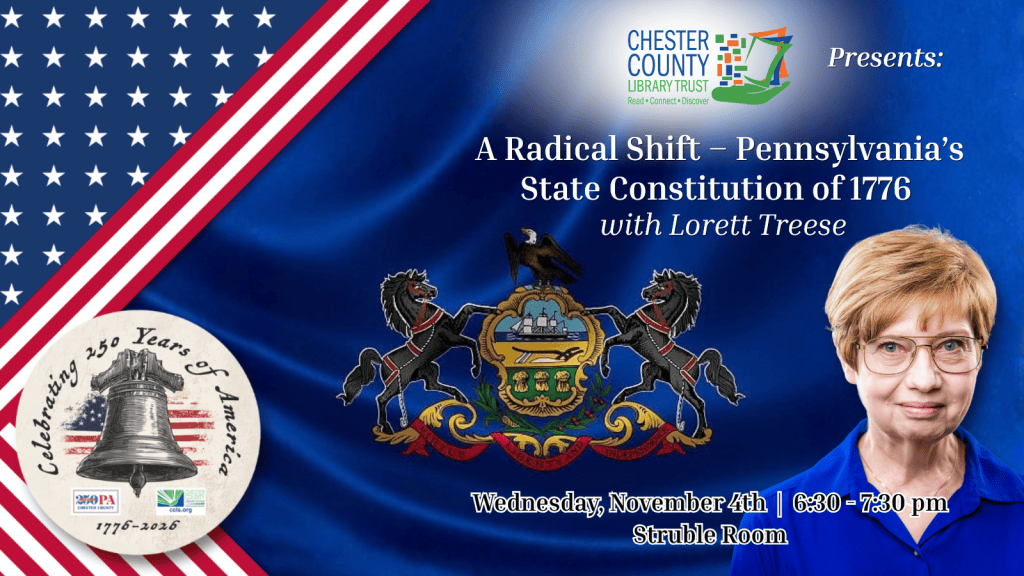
The Chester County Library Trust will host local author and historian Lorett Treese for a public presentation titled “A Radical Shift – Pennsylvania’s State Constitution of 1776,” on Wednesday, November 4, 2026, from 6:30-7:30 pm in the Struble Room at Chester County Library in Exton. The event will explore the creation and significance of Pennsylvania’s groundbreaking 1776 Constitution, a document overshadowed by the Declaration of Independence but central to the political transformation of the Commonwealth.
Treese, a longtime Chester County resident, is a graduate of Bryn Mawr College and holds a Master’s degree in American History from Villanova University. She served more than twenty years as Bryn Mawr College’s archivist and has written extensively on regional history for over three decades. Her publications include The Storm Gathering: The Penn Family and the American Revolution; Valley Forge: Making and Remaking a National Symbol; and several volumes on the railroads of Pennsylvania, New Jersey, and the Eastern Shore.
The public is invited to attend this informative program sponsored by the Chester County Library Trust. Registration is required at https://ccls.libcal.com/event/17776097.
The Board of Trustees of the Chester County Library System/Chester County Library are hosting their monthly board meeting as a hybrid offering. If you have always wanted to attend a meeting but haven’t had the time, this is your opportunity. Please click on this link at 9:00 a.m. on Tuesday, October 20th, to join the Chester County Library System Board Meeting virtually, or attend in person at the Chester County Library, 450 Exton Square Parkway, Exton. The Chester County Library Board Meeting will immediately follow. Find the Chester County Library Board Packet here.
If you are a person with a disability and wish to attend this meeting and require an auxiliary aid, service, or other accommodation to observe or participate in the proceedings, please call Chester County Library’s Administration Office at 610-344-5600 or email ddadoly@ccls.org to discuss how we may best accommodate your needs.
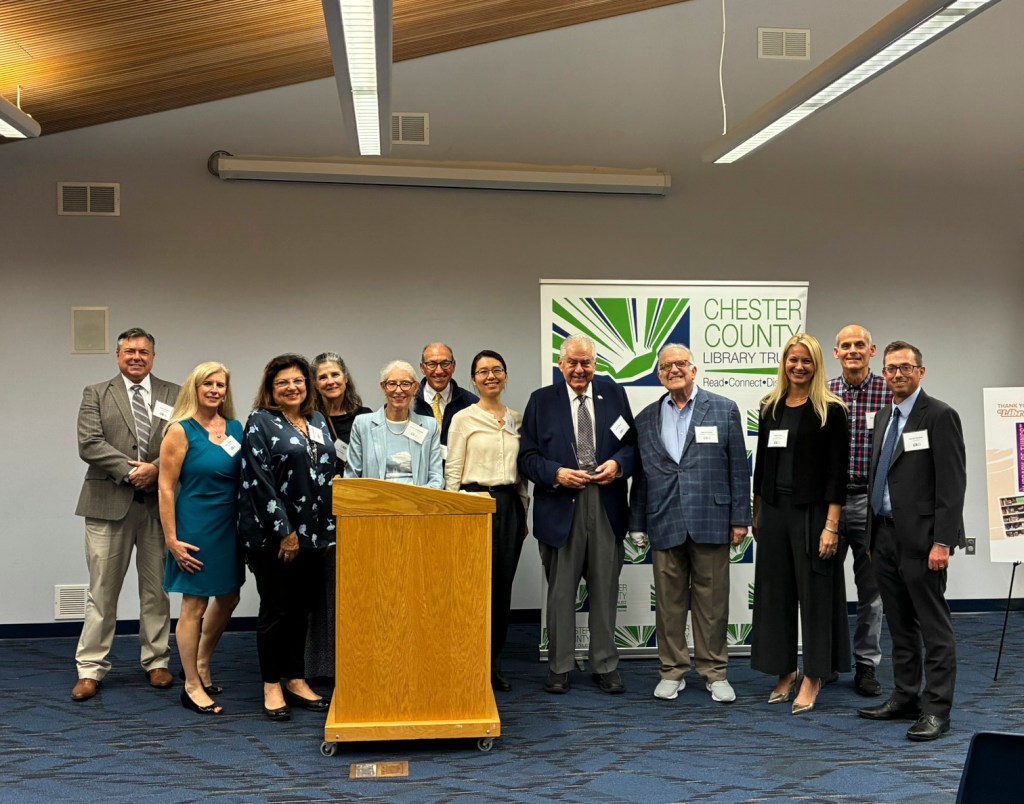
Jim McErlane pictured with Lamb McErlane colleagues and former State Senator Andy Dinniman at the Chester County Library Trust Donor Appreciation Event.
On October 1, the Chester County Library Trust gathered donors and friends in the Struble Room at Chester County Library for its annual Donor Appreciation Event. The evening celebrated the generosity of Trust supporters and recognized James E. McErlane, Esq., whose leadership has shaped the Trust since its beginning.
Jim has been part of the Trust’s story from the very start. When the organization was being established in 2006, he helped guide its formation and served as the Founding President, laying the groundwork for the Trust’s ongoing support of library services at the Chester County Library and Henrietta Hankin Branch. His work during those early years—building policies, refining bylaws, and setting a strong foundation—continues to influence the Trust’s mission today.
The Chester County Commissioners presented Jim with a citation honoring his service, stating, “Jim McErlane is a leader whose enduring commitment to the Chester County Library Trust and the broader community will be felt for generations.”
Former State Senator and Chester County Library Board member Andy Dinniman also praised Jim’s impact, noting his ability to bring people together to solve community problems and concerns. “Every county needs a Jim McErlane to provide this vital function. Chester County has been blessed through Jim’s work.”
Jim’s dedication to Chester County extends far beyond the Trust. A lifelong resident, Navy veteran, Villanova‑trained attorney, and senior partner at Lamb McErlane, he has served on the Supreme Court of Pennsylvania’s Judicial Conduct Board, the Judicial Nominating Advisory Panel for the U.S. District Court for the Eastern District of Pennsylvania, and several local nonprofits and community organizations.
The Trust is grateful to all donors whose support helps strengthen library programs, collections, and services for residents throughout Chester County.
The Chester County Library Trust, a 501(c)3 organization, was established to bridge the gap between traditional funding sources and community needs. The goal of the Trust is to develop financial resources to build collections, expand library programs and services, and support projects the libraries cannot afford through operating budgets. https://chescolibraries.org/about/how-you-can-help/chester-county-library-trust/
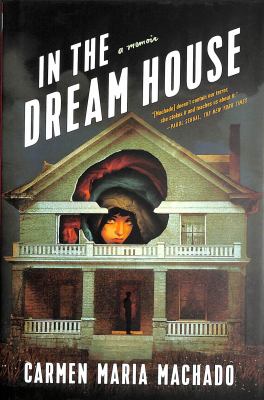
Welcome to the tenth month of this year’s reading challenge! The 2026 Reading Challenge is open to all readers reading at a Young Adult or Adult level in any format. Please register for the challenge this year using this online registration form or by speaking to the Reference Desk. Then, pick up a physical tracking log at the Reference Desk or print one out at home using the link provided in the Resources section of the Reading Challenge page at bit.ly/AdultReadingProgram.
For those of you who joined us for last year’s challenge, you all know the drill! For those who are just joining us this year, I will post the prompt along with some suggested reads and resources here on the blog every month. Different from last year, the prompts this year are “this or that” in style, so you will have more options to choose from! You do not need to read a book from both “this” and “that.” Just one or the other – unless you really want to go the extra mile and read more, in which case don’t let me stop you! But there is no extra prize for doing both. Just brownie points in the eyes of the librarians.
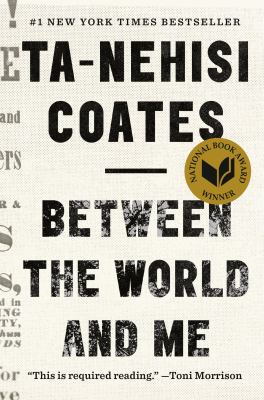
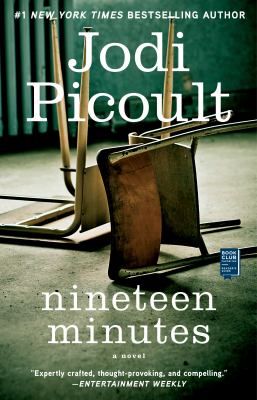
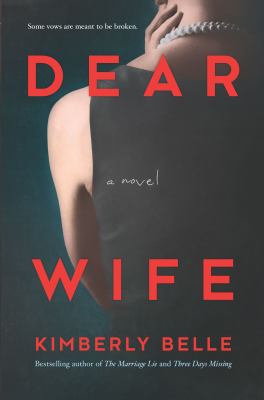
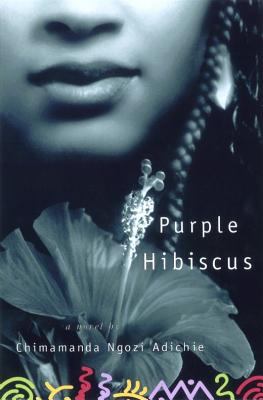
October’s reading challenge prompt is “A banned or challenged book” OR “A book for Domestic Violence Awareness Month.”
Need inspiration for what to read? Check out a few suggested reads below! See the full lists on our catalog here:banned/challenge booksor books for Domestic Violence Awareness Month* (titles suggested by the Domestic Violence Center of Chester County). Make sure to also visit the library to explore our interactive book display.
P.S. If you’ve made it all the way to the end, comment a heart under this post! ❤
*CONTENT WARNING – Most of the books on this list, due to the nature of the issue of Domestic Violence, may depict graphic accounts of violence: verbal, emotional, and sexual/physical abuse, and some may have explicit language and even discussion of homicide.
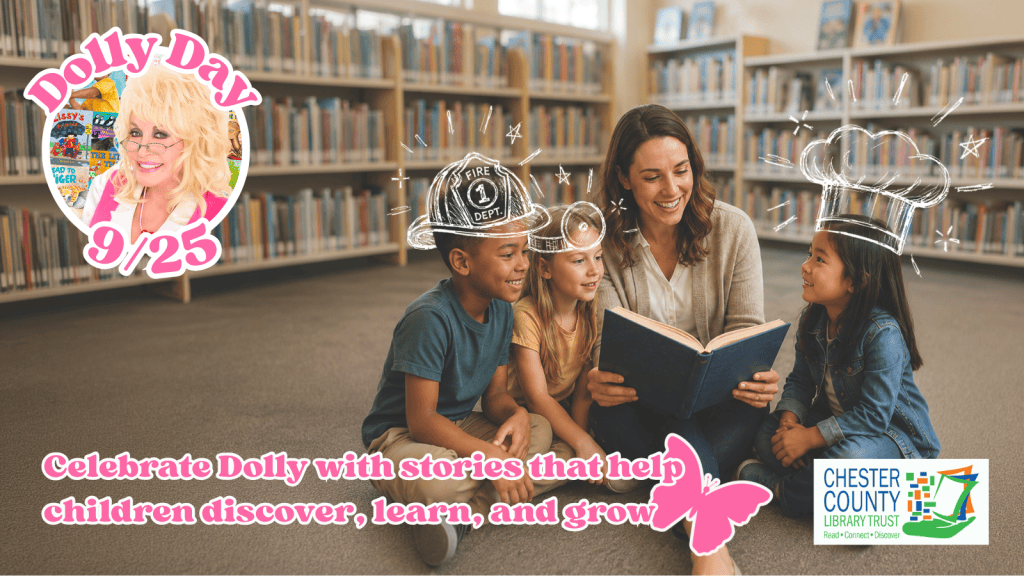
As we recognize the extraordinary life of Dolly Parton and her philanthropic legacy on 9/25 Day, we’re celebrating the generous spirit of giving that helps children in our community discover, learn, and grow at the Chester County Library and Henrietta Hankin Branch.
Through the Chester County Library Trust (CCLT), our supporters help expand our collections, programs, and services beyond what operating budgets can provide. Gifts to the CCLT in recent years have funded our museum passes, Citizen Science Kits, the StoryWalk at Exton Park, Tonie Boxes, and much more!
So today, we’re saying thank you to everyone who has supported the CCLT. We’re especially grateful to those who have chosen to honor Dolly’s memory by supporting the library. Your generosity makes a difference in the lives of local children and families every day. Want to learn more about the CCLT? Visit https://chescolibraries.org/about/how-you-can-help/chester-county-library-trust/
THE FRIENDS OF CHESTER COUNTY LIBRARY FALL BOOK SALE is scheduled for October 9-11. A variety of books, music and movie CDs and DVDs will be sold at bargain prices. A large selection of children’s books will be available in a separate room.
Friday, October 9, 6 to 8:30 p.m. — The sale starts for members of the Friends of the Chester County Library only. Memberships can be purchased on Friday night beginning at 5 p.m. at the membership table or in advance by mailing in the membership form available at the Library or on our website.
Saturday, October 10, 9:30 a.m. to 4:00 p.m. — The sale will be open to the public.
Sunday, October 11, 1 to 4 p.m. — During ‘Bag Sale Day’ we will supply the bag; you fill it and pay $10 (only $7 per bag with your current FRIENDS membership card). For less than a whole bag, the books will be sold at half-price.
We accept cash, checks, PayPal and Venmo. All proceeds from the Book Sale benefit the Chester County Library. Mark your calendars and don’t miss this wonderful opportunity to stock up on great reads while supporting your local library!
Looking ahead: Our Spring Book Sale dates are currently scheduled for April 9th-11th, 2027.
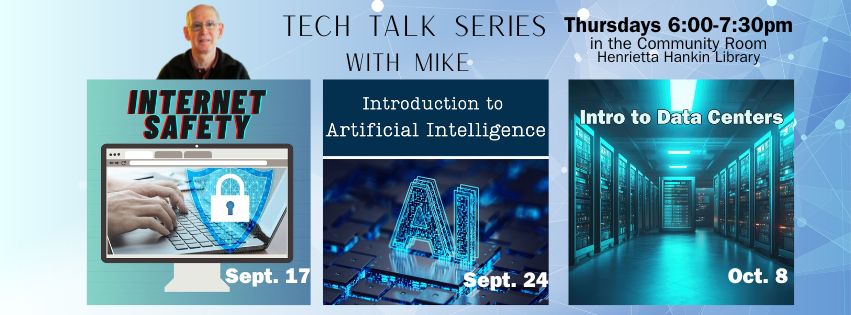
Please take note of important and informative programming at Henrietta Hankin Branch Library! Mike Sheldon, long-time technology tutor and lecturer for Chester County Library and Henrietta Hankin Branch, has put together a series of lectures to help put you “in the know” on important and timely technology topics. Mike worked in the computer industry for 37 years (retiring in 2012) before becoming involved as a volunteer for the Chester County Library System. He enjoys vigorously keeping himself informed of the latest technology trends and passing his knowledge along to the community.
The presentations will start off on Thursday, September 17th, with “Internet Safety.” Learn to protect your devices, surf the web securely, and manage passwords like a pro. This workshop covers email safety, secure Wi-Fi access, and the latest smart social media habits. Don’t leave your digital security to chance—join us and take control! For more information, and to register for this event, click here.
The following Thursday, September 24th, join us for “An Intro to Artificial Intelligence.” What does the rise of Artificial Intelligence (AI) truly mean for our future? This presentation demystifies AI by breaking down its core definitions and capabilities. We will examine how the emergence of these technologies is actively reshaping our security, culture and driving global economic shifts. Join us to gain essential insights into navigating this rapidly changing landscape. For more information and to register for this event, click here.
The Tech Talk series will wrap up on Thursday, October 8th, with “Intro to Data Centers.” Get a comprehensive look at the infrastructure powering modern technology. This presentation explores the fundamental purpose of data centers, maps their core components, and analyzes critical external requirements like land, power, and water. We will examine why data center demand is skyrocketing and dissect the operational and environmental challenges facing the industry today. The talk will conclude with an interactive Q&A session. To register for this event, click here.
Each of these Thursday lectures will take place from 6:00-7:30 pm in the Community Room at Henrietta Hankin Library. We hope you can join us! Henrietta Hankin Library supports PA Forward Information Literacy.
The Board of Trustees of the Chester County Library System/Chester County Library is hosting its monthly board meeting as a hybrid offering. If you have always wanted to attend a meeting but haven’t had the time, this is your opportunity. Please click on this link at 9:00 a.m. on Tuesday, September 15th, to join the Chester County Library System Board Meeting virtually, or attend in person at the Oxford Library Company, 48 S. Second Street, Oxford, PA 19363. The Chester County Library Board Meeting will immediately follow. Find the Chester County Library Board Packet here.
If you are a person with a disability and wish to attend this meeting and require an auxiliary aid, service, or other accommodation to observe or participate in the proceedings, please call Chester County Library’s Administration Office at 610-344-5600 or email ddadoly@ccls.org to discuss how we may best accommodate your needs.
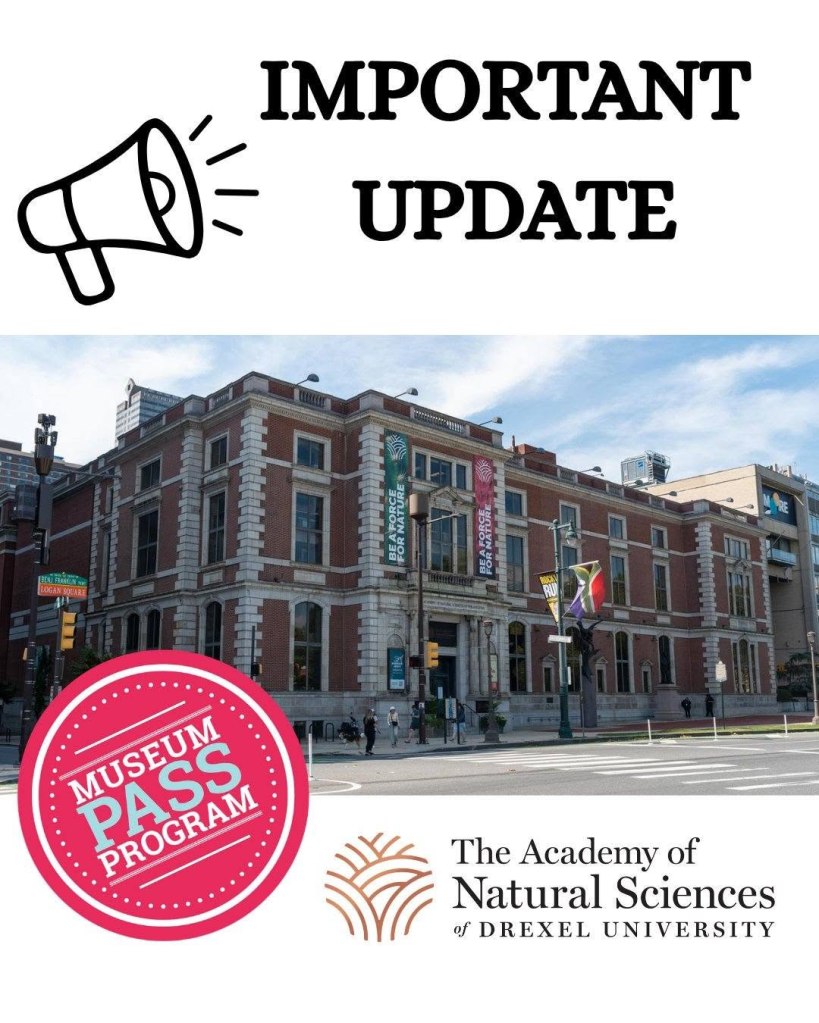
Unfortunately, we have some sad news to share – The Academy of Natural Sciences will be permanently closing its doors after nearly 200 years of service at the end of this month. Their last day will be Sunday, September 27.
Patrons can still reserve museum passes through this closing date, but none will be issued after.
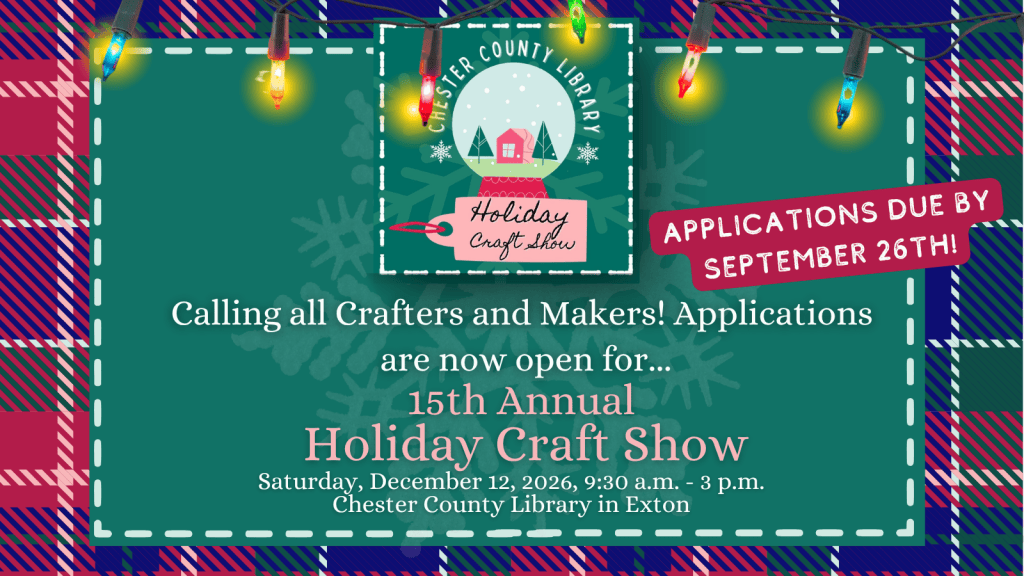
The Chester County Library is now accepting vendor applications for our 15th Annual Holiday Craft Show, happening Saturday, December 12, 2026, from 9:30 a.m.–3:00 p.m. Apply by Monday, September 28, to be considered; accepted vendors will be notified by Monday, October 5.
This festive, high‑traffic event offers artists and makers a chance to showcase their work to hundreds of shoppers in a welcoming, community‑driven atmosphere. Our show celebrates creativity with an exceptional selection of handmade, artist‑designed goods—and many vendors leave with a brand‑new base of loyal customers.