This animated mini-series, which debuted on Cartoon Network back in 2014, is quietly one of the best, most fully-realized, and lovingly-crafted pieces of art of the last 20 years. Pulling its inspirations from illustrations by Gustave Doré, Hans Christian Anderson, children’s books of the 1800s, folk art and American music from the early 20th century, the series crafts an atmosphere that is at once both undeniably familiar and singularly unique.
The show features an incredible voice cast starring Elijah Wood, Melanie Lynskey, Christopher Lloyd, Tim Curry, and John Cleese. However, it is undeniable that the show’s true stand out is Elijah Wood’s 9 year old co-star Collin Dean who steals absolutely every scene he is in. Unlike most of today’s children’s programing, this series feels like a return to a time when children’s stories had genuine moments of fright and suspense. The gorgeous, rich, art design of the series is steeped in autumnal imagery, making it a perfect watch to get you and your family in the mood for the fall and Halloween season. For a more in depth review of this series check out this month’s blog post all about it by clicking the link below!
The fifth and most recent album from one of this generation’s most singular and consistently evolving artists, Florence Welch. Dance Fever delivers the same amount heart-swelling, emotional vocals and synth-rock bangers that fans come to expect from a new Florence and the Machine album while adding plenty of new colors to the band’s ever-expanding palette. Welch’s lyrics, in particular, reach a new stratosphere with this album, especially on tracks such as “Dream Girl Evil” and “King”, giving Dance Fever a level of richness that can only be mined from multiple listens.
His facility with planning large operations, Adolph Eichmann ingratiated himself with such murderous Nazi delinquents as Reinhard “The Butcher” Heydrich and Heinrich Himmler, for whom he designed extermination camps for Jews and other “undesirables.” Escaping from Europe at the close of the World War II, Eichmann made his way to Argentina, where in 1959 he was kidnapped by Israeli security personnel and transported to Tel Aviv by plane and tried for, among other charges, crimes against humanity, and he was executed by hanging in 1962. Hunting Eichmann reads like a thrilling spy novel, but it’s all true and hard to put down.
One of the seminal action films for Steve McQueen and director Sam Peckinpah. Getting the money, losing the money, getting it back again, and making the getaway. Violent and occasionally amusing, as when on the train McQueen pummels a grinning Richard Bright (the Corleone family’s favorite hitman) who can’t believe he’s stumbled onto a stash of cash, and when McQueen and Ali McGraw slide from a garbage truck into a landfill.
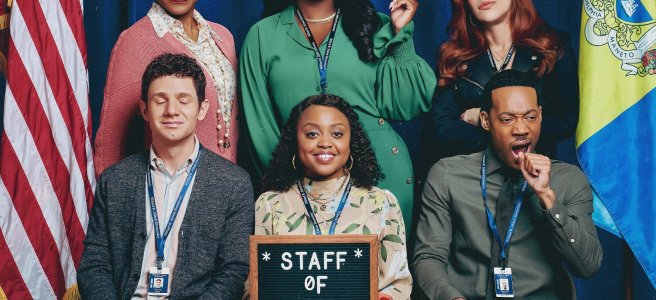
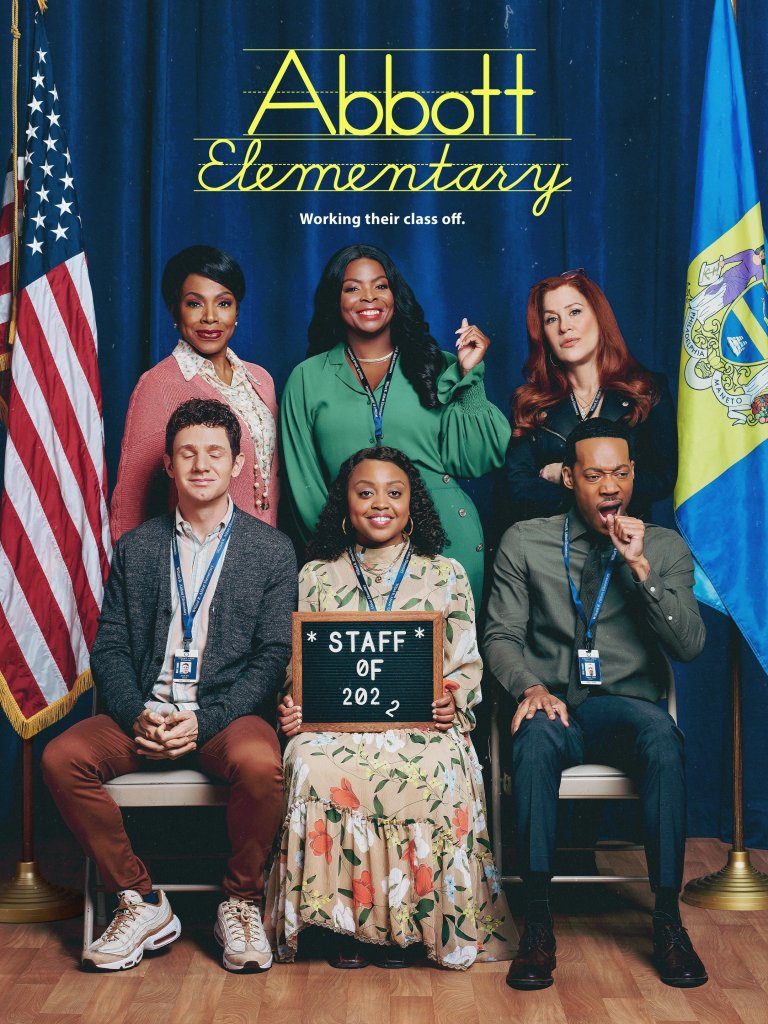
This space western TV show is one of my favorite Science Fiction shows. It has good worldbuilding, a great cast, and humor – a good fit for Guardians of the Galaxy fans!
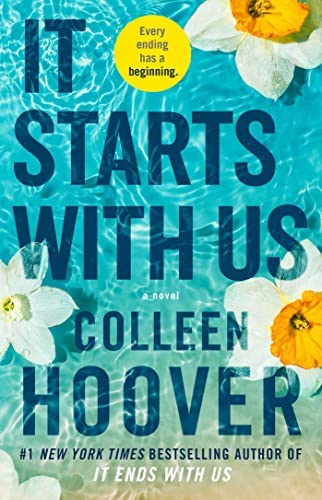
Lead singer Rachel Price has a great voice and it fits wonderfully with the group’s 60’s and 70’s inspired music. Check out the songs “Call Off Your Dogs,” “I Don’t Care About You,” and “Can’t Stop.”
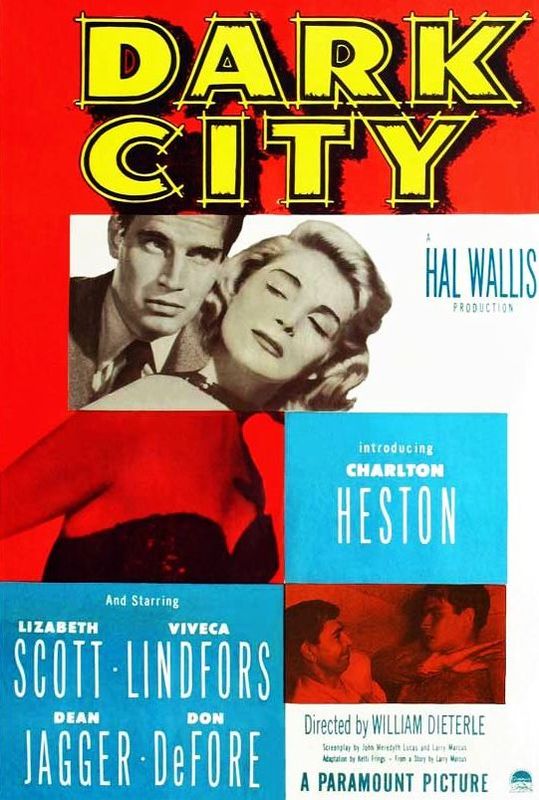
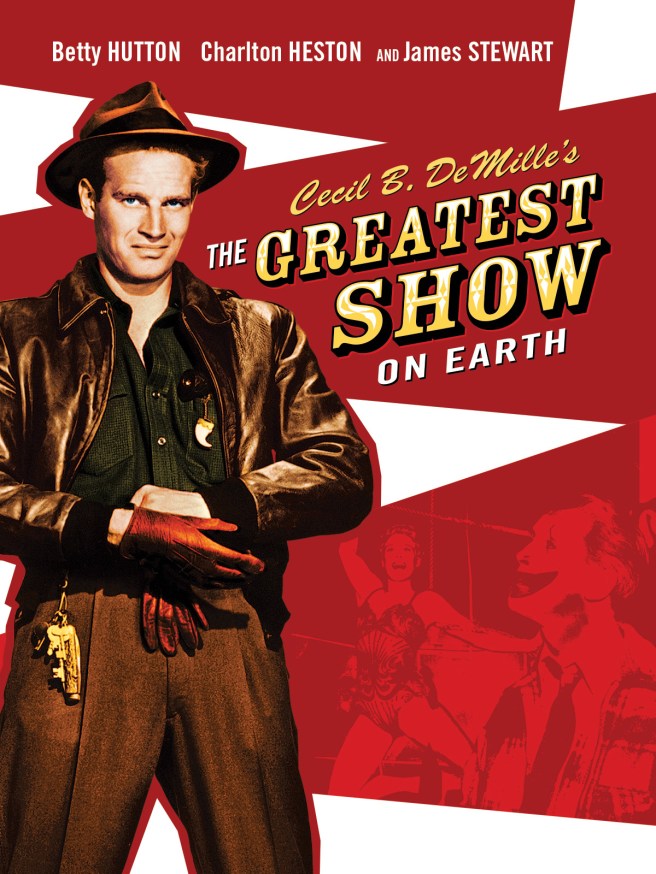
Charlton Heston was a leading man in his first movie, the noir Dark City (1950), and in 1952 famed director Cecil B. DeMille chose him to headline The Greatest Show on Earth, the eventual Best Picture Academy Award winner. That led to another DeMille epic, The Ten Commandments (1956) with Heston as Moses. Heston’s physical stature was perfect for such films, as Laurence Olivier observed. In 1959 he won the Best Actor Academy Award for the title role in that most honored Biblical extravaganza, Ben-Hur. That was followed in 1961 by yet another medieval epic, El Cid, with Heston as the Spanish knight negotiating his way between Christian Castile and the Muslims controlling southern Spain. On a more modest scale came The War Lord (1964). The knight Chrysagon (Heston) is entailed with protecting a Norman community threatened by Frisian marauders.
An assortment of roles followed in various genres, some good, like the western Will Penny (1968), some merely fair like the WW II suspense film, Counterpoint, also 1968.
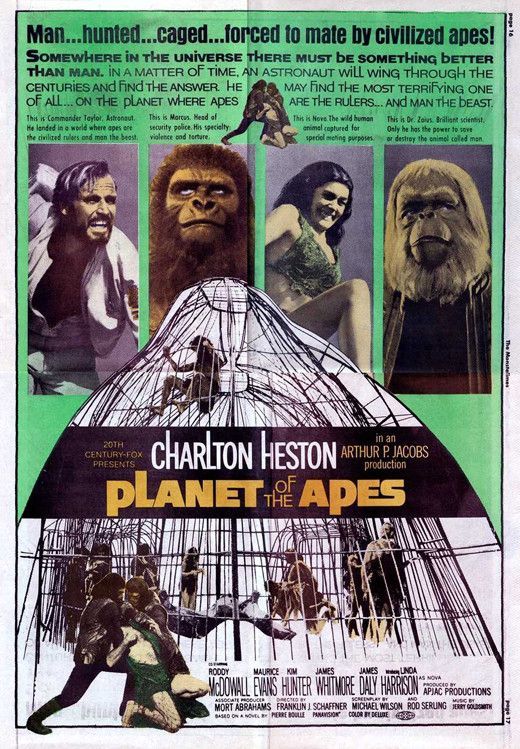
The third time was the charm: Planet of the Apes. Writer and teacher Robert Castle wondered if Apes won the Honorary Academy Award for Makeup because the voters thought the primates in the same year’s 2001: A Space Odyssey were actual apes! So, 1968 was a key year in science fiction, which had been playing second fiddle to Hammer Studios’ horror films in the realm of the fantastic. Apes and 2001 resuscitated the genre, and both were commercial successes.
In his autobiography In the Arena, Heston said after finishing the Planet of the Apes shoot on schedule he had a drink with director Franklin Schaffner and told him, “I smelled a hit in this from the beginning,…” He was correct. “It not only grossed enormous numbers, it created a new film genre: the space opera.”
In 1971 the second outing in what would be a sci-fi triptych for Heston was The Omega Man, a new version of Richard Matheson’s tale of a future earth after a biological holocaust decimated the population and turned some into mutants—or vampires. It followed the Italian rendering, The Last Man on Earth (1964) with Vincent Price and preceded the high tech I Am Legend (2007) with Will Smith. The Omega Man has several gripping scenes, e.g., Heston driving through a desolate Los Angeles; pulling a sheet from what he imagined to be couple of mutants but instead discovers the desiccated corpses of two lovers; battling his way back into his garage at nightfall against the crazed, robed and anti-technology survivors of the plague who now call themselves the “Family.” Ron Grainer’s score enhanced the action.
In In the Arena, Heston said the shoot went smoothly and swiftly and was his first hit in four years. He liked the final product. “It’s become something of a cult film since, still pumping in checks every so often. I think we’d had a chance to make a really fine film of Omega, but I was quite willing to settle for a merely successful one at the time.
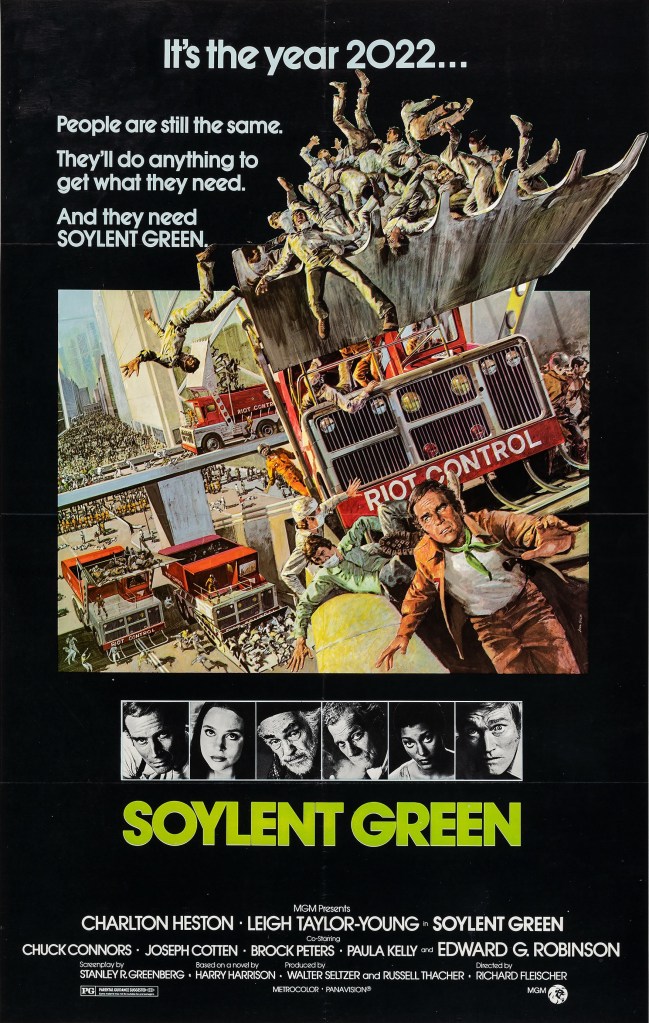
Soylent Green (1973) was, like The Omega Man, a bit “under-funded” but nevertheless possessed of some arresting scenes. Heston played Detective Thorn, who in 2022 investigates a murder that leads to a shocking revelation. Just what is the stuff people are eating? Issues tackled include overpopulation, dying oceans, pollution, and the greenhouse effect. Sound familiar?
References
Heston, Charlton. The Actor’s Life: Journals 1956-1976. 1978.
On November 3rd of 2014, an animated mini series called Over the Garden Wall was unceremoniously released onto Cartoon Network with almost no fanfare or hype, despite a cast which featured the likes of Elijah Wood, Christopher Lloyd, and John Cleese. The mini-series seemed to simply roll in with the autumn wind and ever since its brief 10-episode run from November 3rd to November 7th, it has become beloved as an autumnal re-watch, building legions of fans with each passing year. So what is it about this humble little “cottage-core” show that has caused it to amass such a massive fan base?
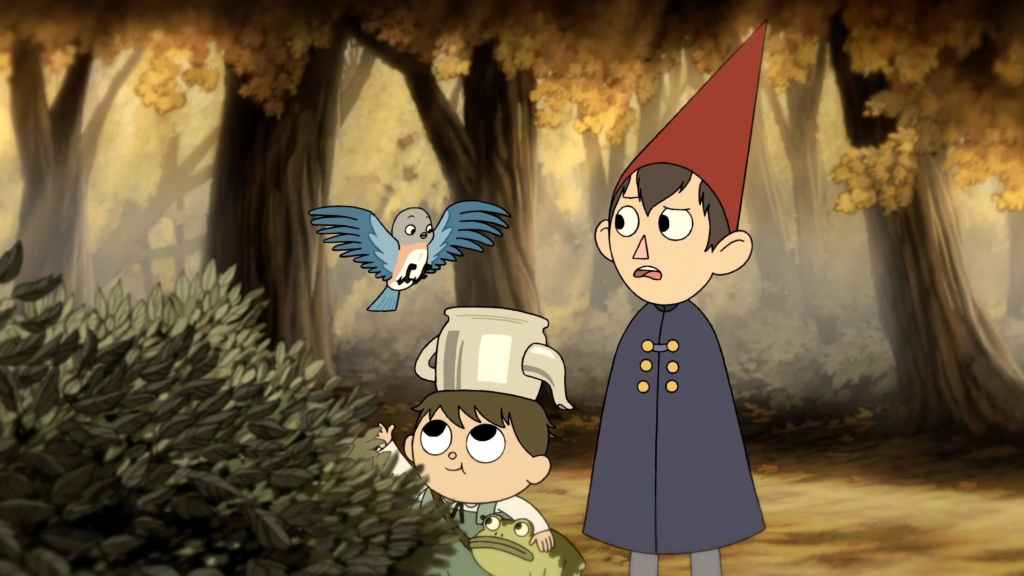
If you have never seen Over the Garden Wall, the story follows two children: Wirt (voiced Elijah Wood) and his much younger half-brother Gregory (voiced by Collin Dean), who have found themselves lost within a mysterious forest called “The Unknown”. With the aide of a talking bluebird named Beatrice (Melanie Lynskey), the boys try to find their way back home through the increasingly weird and spooky situations that each new environment thrusts them into. Each episode is structured around the trio wandering into a radically different area of The Unknown where they will encounter new characters, new problems to solve, and new clues to help solve the overarching mystery of the woods.
(Beatrice, Greg, and Wirt’s first meeting in the mysterious woods)
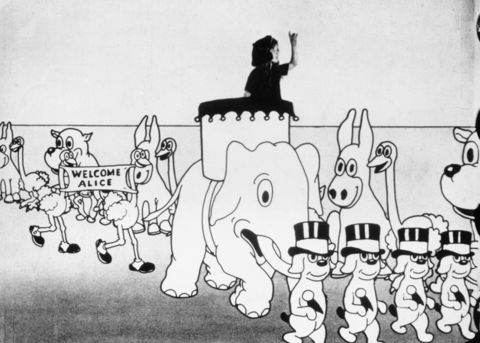
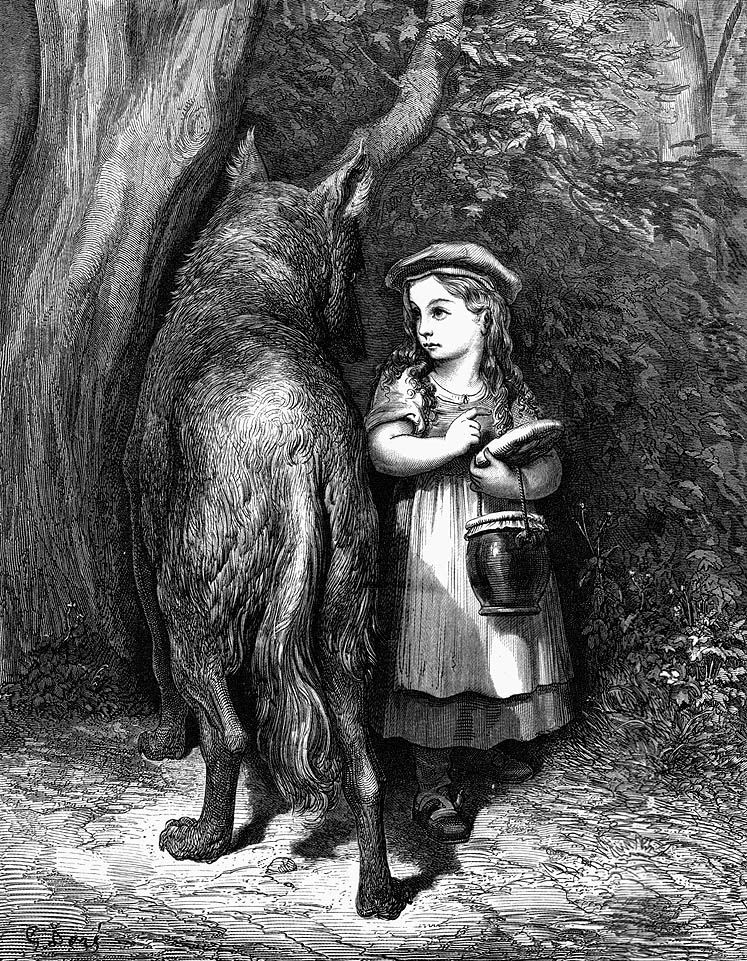
On paper that may seem like a fairly vague and possibly even “garden-variety” fairytale structure, but the success of Over the Garden Wall comes from its unique voice, proving that how a story is told is just as important as the story itself. Over the Garden Wall is primarily the brainchild of it’s creator and showrunner Patrick McHale, a man who was no stranger to the world of children’s animation or Cartoon Network for that matter. Prior to Over the Garden Wall, McHale had already built a strong relationship with Cartoon Network, previously working on such series as The Misadventures of Flapjack and the cultural phenomenon that was Adventure Time; a show whose style of humor and visual aesthetic still serves as the main influence on the landscape of modern children’s cartoons. It feels important to note Adventure Time, in particular, as it may be the closest comparison point that comes to mind when recommending this series. However, I would argue that the similarities between the two begin and end with their post-modern sense of humor, which bounces back and forth between being completely earnest one moment and joyfully flippant in the next. When it comes to their visual aesthetics, however, the two shows are night and day. Where Adventure Time’s art design is extremely modern, deploying its bright neon color palate to craft an environment so sugary it could give you a cavity, Over the Garden Wall is decidedly old-fashioned and familiar. Many fans have commented on their love for the atmosphere and art design of Over the Garden Wall, specifying that it manages to feel extremely familiar while remaining deceptively hard to identify what is so familiar about it. According to McHale, the show’s aesthetic was the culmination of a variety of different influences “including children’s books of the 1800s, folk art and American music from the early 20th century” (Day, 2014, para. 6). In a 2014 interview with the Los Angeles Times, McHale states “There are a lot of layouts borrowed from Gustav Doré . . . And also from Disney’s early ‘Alice’ shorts” (Day, 2014, para. 7).
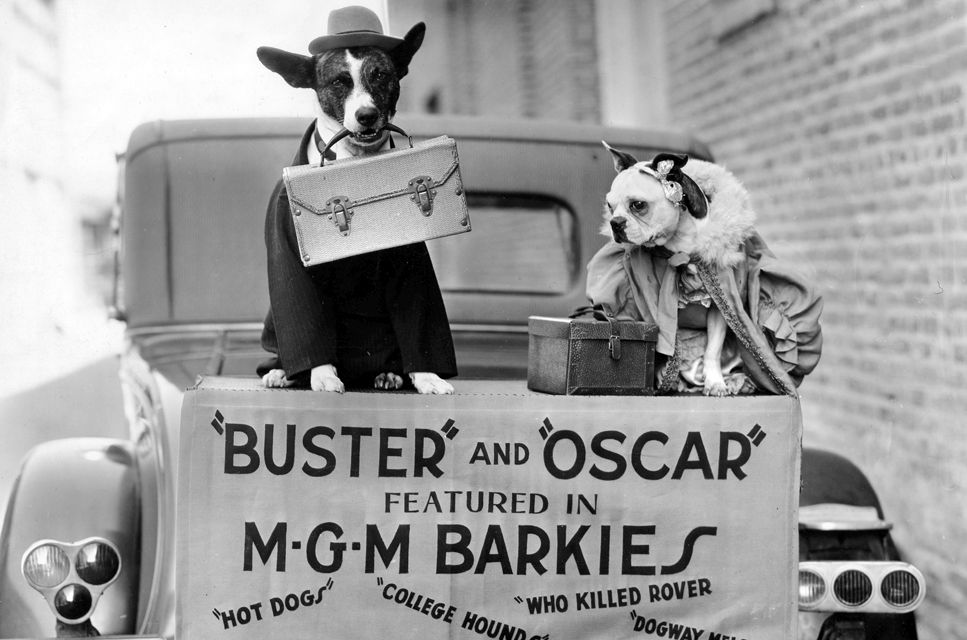
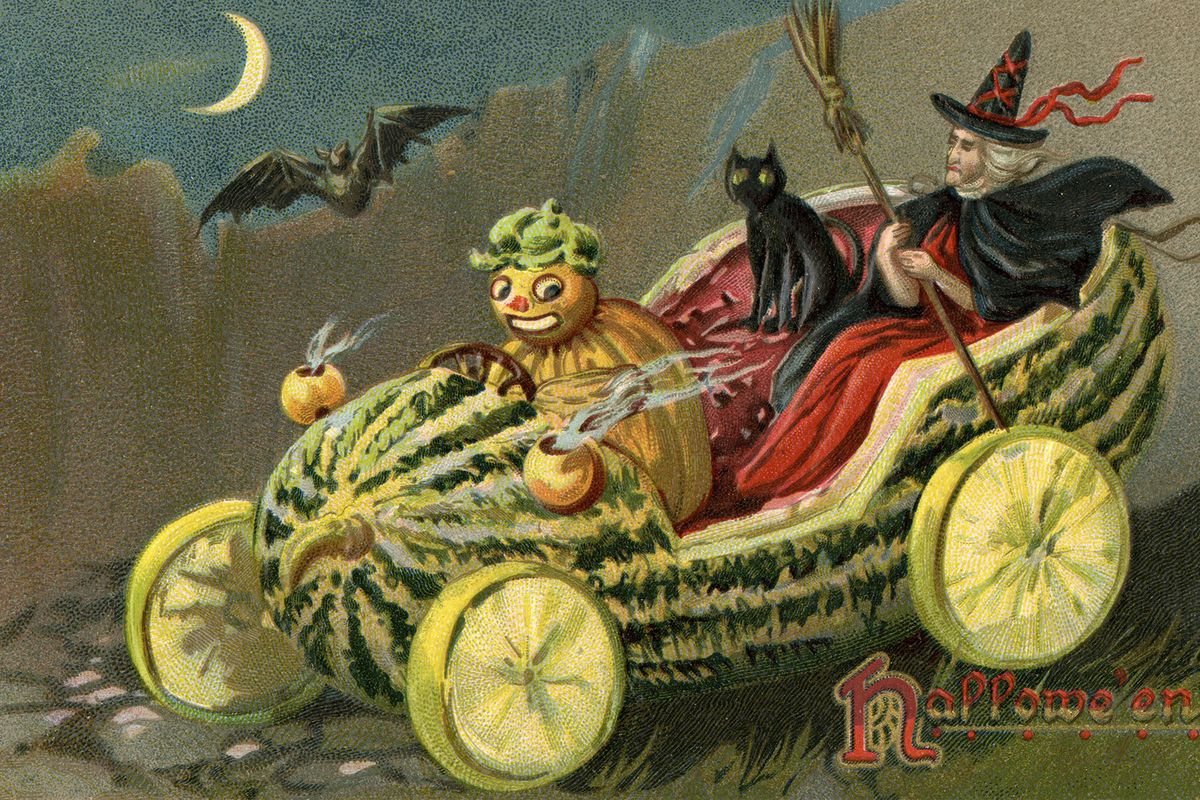
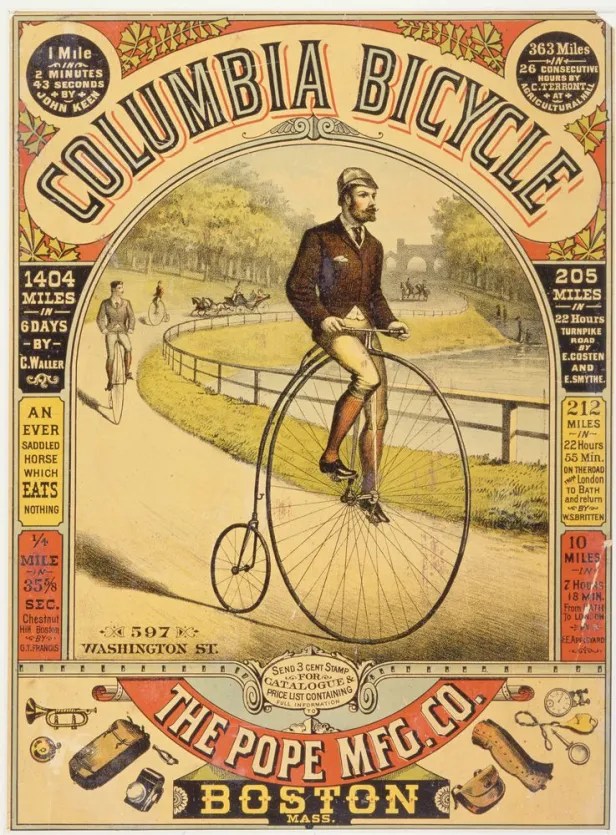
For those who may be unaware Gustav Doré was a French illustrator renowned for wood-engraved illustrations. Some examples of his work can be seen in “The Divine Comedy” and “Paradise Lost”. As for the Disney Alice shorts’; in the 1920s, the Walt Disney company made shorts that were half live-action and half animated. Some other notable artistic influences are illustrations from old Hans Christian Andersen stories such as The Tinderbox, the “Dogville Comedies” shorts, vintage Halloween postcards, and chromolithography. All of these different visual influences become enmeshed to create the overall look of the show and it is truly astonishing how well each one fits together and serve to compliment each other. It is this level of care and detail that manages to serve the overall mood of the story; a seemingly warm and friendly mood that contains unexpected complexities and dimensions for both its characters and the story itself.
Visual Influences of Over the Garden Wall
One such added dimension is that the show takes on a noticeably darker tone with each episode, giving its protagonists real stakes and imbuing their circumstances with tangible weight. While a perfectly appropriate show for most families to watch together, there does tend to be some darker elements involving spooky situations or creepy looking monsters that may prove a bit too scary for some of the younger viewers. However, it is these surprisingly darker elements that make the program feel truly unique among much of today’s children’s programs; many of which avoid age-appropriate elements of suspense and horror all together for fear of negative backlash. This well intentioned choice can unfortunately result in content that talks down to children or patronizes them.
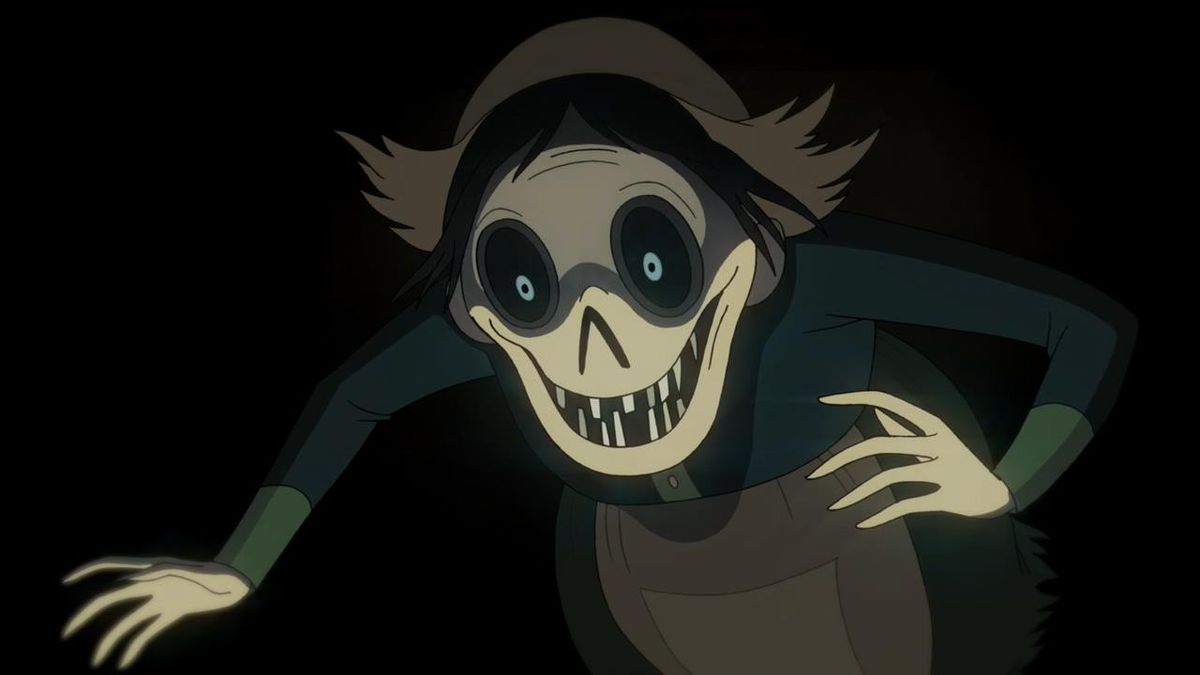
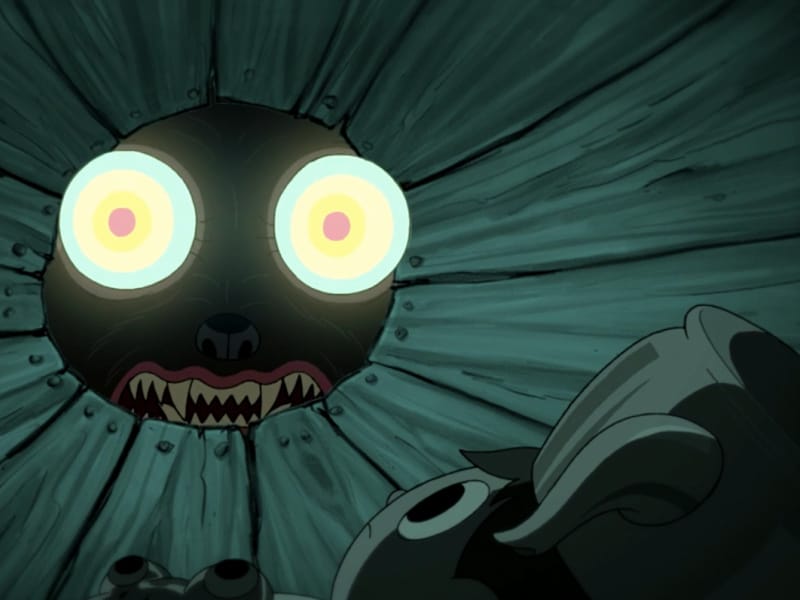
While the show arguably never strays too far into the Horror genre, it does allow itself to provide moments of true suspense and age-appropriate scares. This choice is one that is very much fitting with the subject matter of the show. McHale uses the more nightmarish imagery in a way that feels like he is acknowledging the roots of children’s fables from its earliest days. In fact, the majority of well-known children’s fairy tales are often greatly altered from the original versions which were often very horrific. (Look up the original versions of such stories as The LittleMermaid and Pinocchio if you don’t believe me.) While this is fun part of the show’s dynamic, the elements of horror would be nothing without the magic that lies at the heart of the story: the half-brothers Gregory and Wirt.
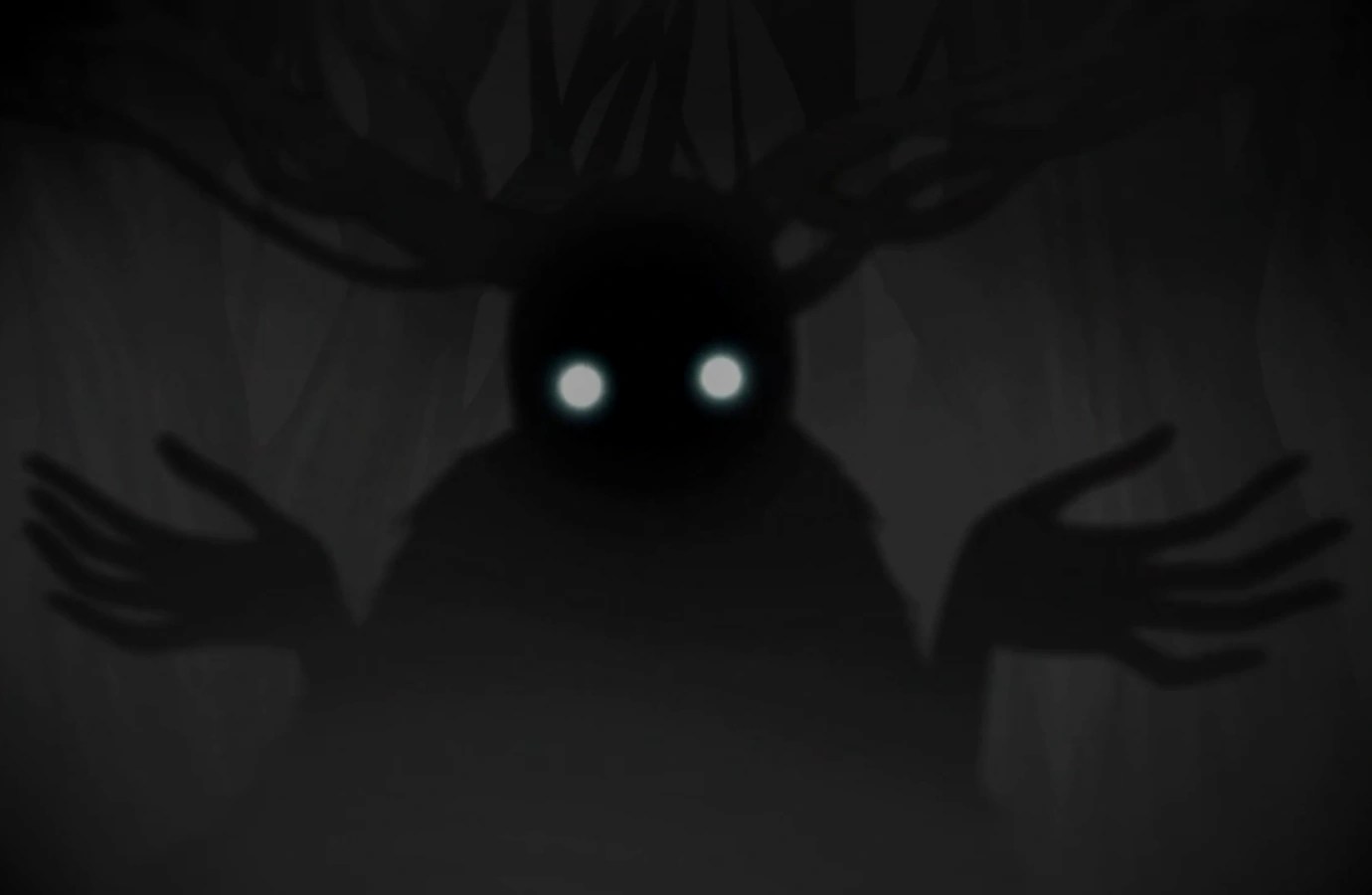
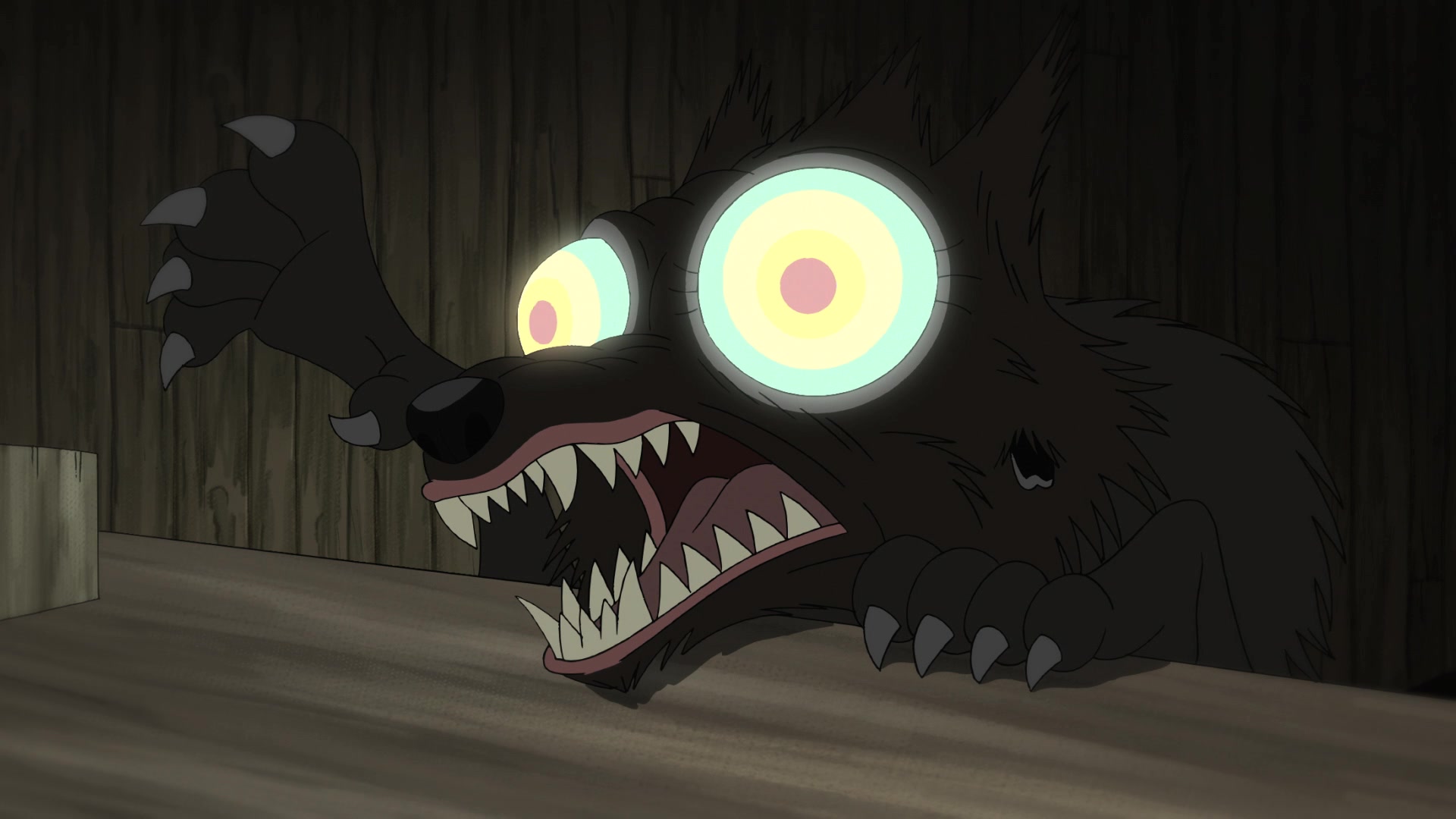
Moments of horror in Over the Garden Wall
Beyond the horror, beyond the humor, beyond the beautiful painted vistas of the show’s art direction; I believe that Over the Garden Wall has become a beloved piece of pop culture because of the story at its center: a story about the relationship between anxiety-ridden teenager Wirt and his silly, carefree, 5-year old brother Greg. There is something so simple, so elemental about their dynamic that their characters feel practically timeless. While much of their adventures has a humorous tone, the show does build to a truly cathartic and heartfelt conclusion which focuses heavily on the still newly burgeoning relationship between the two half-brothers. McHale and company do a truly great job developing such iconic new characters in Greg and Wirt that you instantly fall in love with; Greg in particular who was voiced by a real child which gives his character a special added layer of authenticity. In fact, even though seasoned veterans of the screen such as Wood and Lynskey deliver excellent performances, it is undeniably 9-year old Collin Dean (Greg) who steals the show.
In trying to synthesize why this mini-series has become a yearly re-watch for so many people, myself included, it is easy to see that there is a lot to love. It is genuinely funny for people of all ages; the art direction for the show is incredible; the central characters are lovable, and the performances are all top notch. But, if we are being completely honest, it’s also probably the fact that the show is brimming with Autumnal imagery and its the perfect thing to get you in the mood for the fall season.
So throw on your comfiest fall sweater, pour yourself some hot apple cider, and curl up with your family to start a new yearly ritual with this seasonal treat!
By Eric
References
Day, P. K. (2014, October 3). ‘Over the Garden Wall’ gets lost in creator’s imagination. Retrieved September 21, 2022, from ‘Over the Garden Wall’ gets lost in creator’s imagination
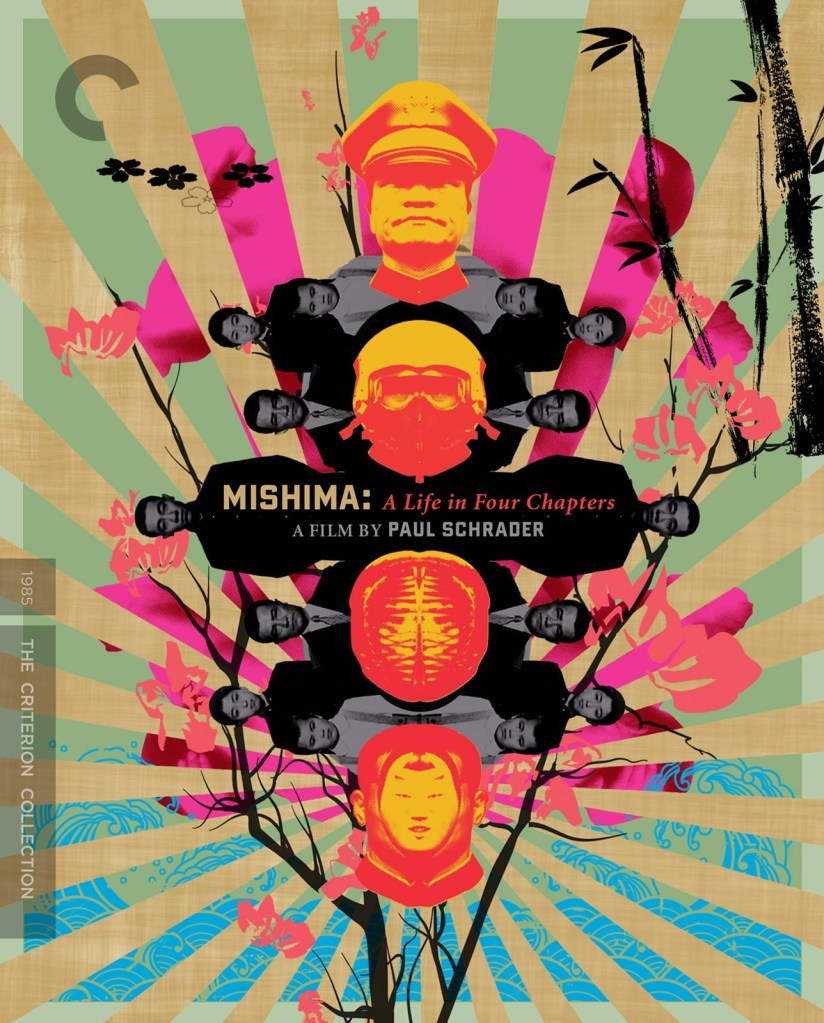
This film combines the stories and life of infamous Japanese Author Yukio Mishima into an absolutely stunning film, directed by Paul Schrader. Has some of my favorite production design, and is my all-time favorite film soundtrack.
A haunting, experimental, memoir about an abusive relationship, read by the author. It’s an important read that I can’t recommend enough, especially for those in the LGBTQIA+ community.
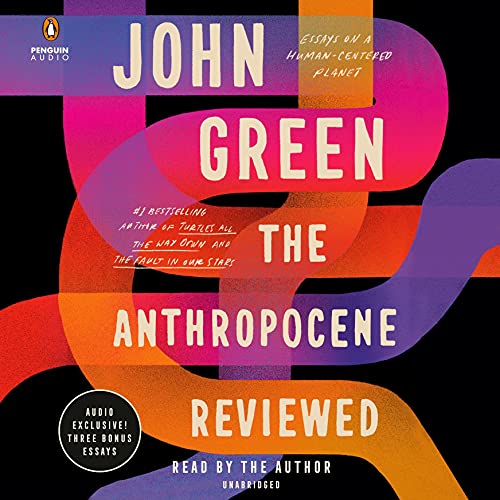
The author of The Fault in Our Stars, Green offers an amusing and insightful take on various elements of our time, what is currently termed the Anthropocene, and ranks each on a 5-star scale. Topics include smallpox and pandemics, Canada geese, Indianapolis, typewriter keyboards, oddball roadside attractions, extinct Hawaiian birds, and Nathan’s hotdog eating contest. It sounds like therapy for Green, who admits to a lifetime of despair as well as hope.
To be read alongside Yuval Noah Harari’s Sapiens: A Brief History of Humankind and Ed Yong’s An Immense World: How Animal Senses Reveal the Hidden Realms Around Us.
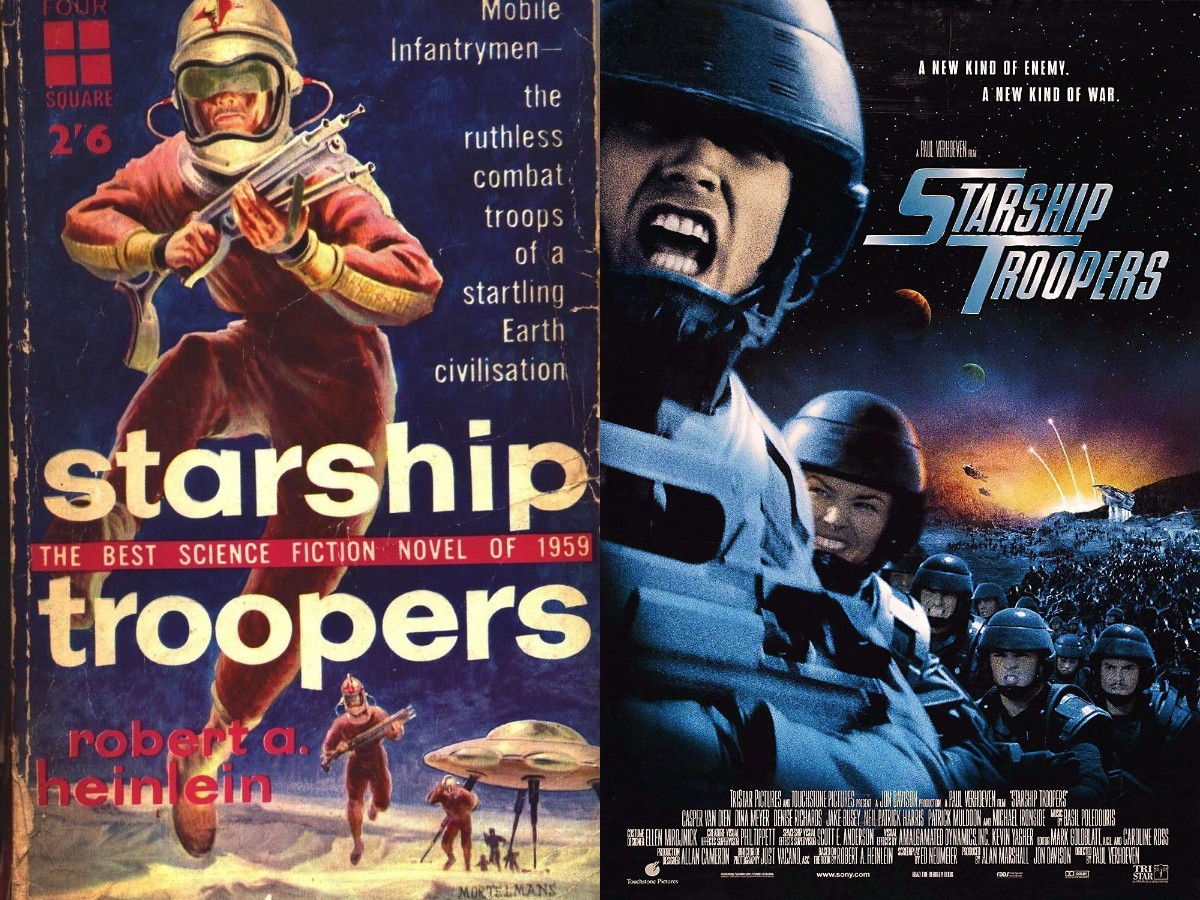
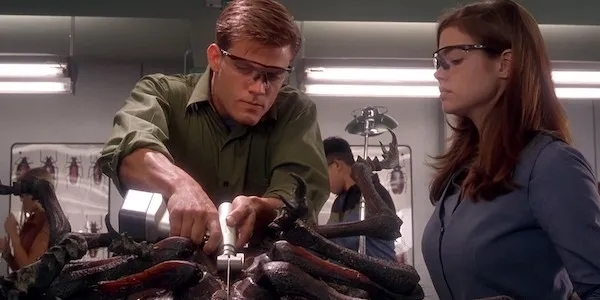
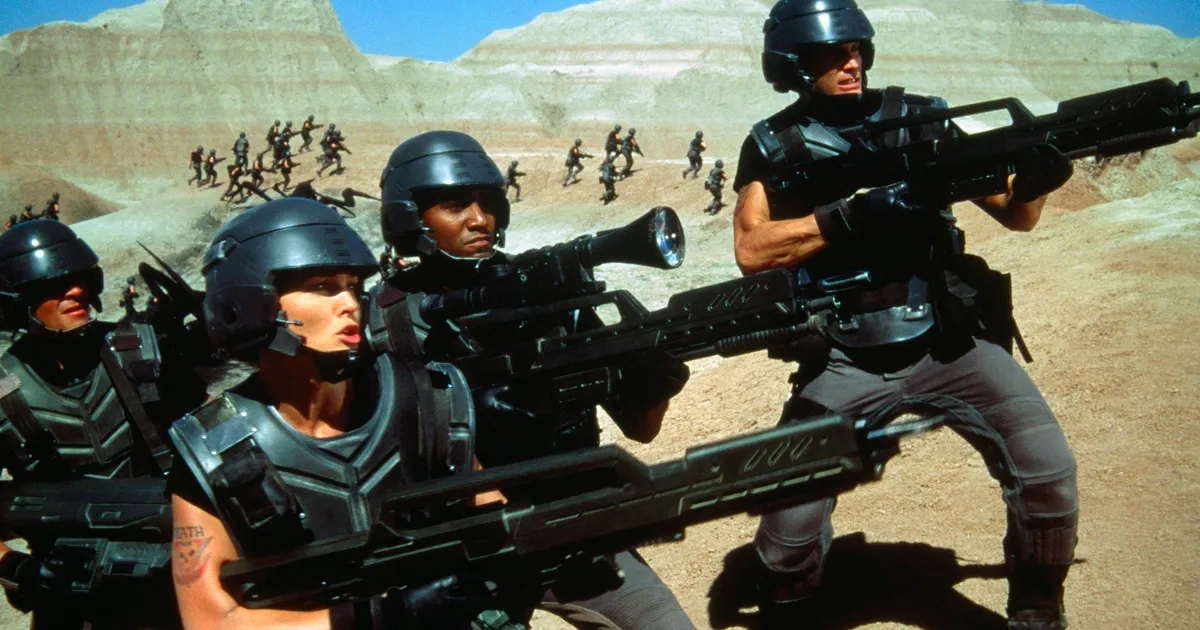
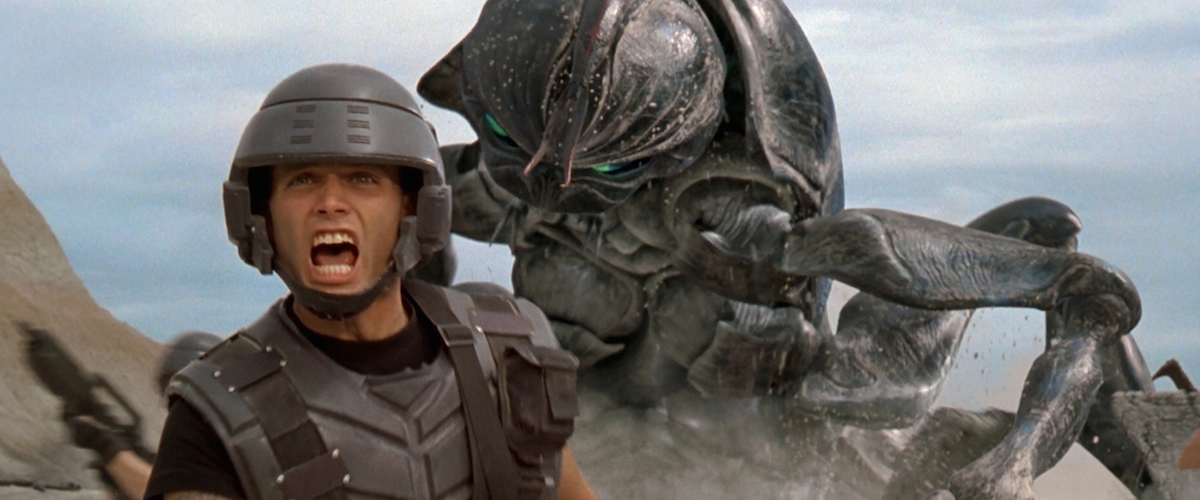
Paul Verhoeven’s satirical masterpiece about a future war between Earth’s military forces and a planet full of giant alien bugs! This movie is unlike anything I have ever seen; simultaneously existing as extremely high-brow and low-brow entertainment. Starship Troopers manages to be a big, loud, sci-fi action blockbuster, full of explosions, guns, and gore, while also serving as a scathing commentary on the military industrial complex and media propaganda. It is truly a film you can enjoy as either mindless fun or as a deeply cerebral experience. (See this month’s blog post for a deep dive on the context of this film’s history!)
Insane, Colorful, Action-Packed, and Hilarious!!! This game is a feast for the eyes; offering a wild, open-world ride that will entertain everyone from the lifelong gamer to the relative newbie. Traverse the cartoonish metropolis of Sunset City and fight off swarms of mutant zombies while grinding on telephone wires, leaping off skyscrapers, and firing an array of the weirdest assortment of weapons ever assembled in a video game!
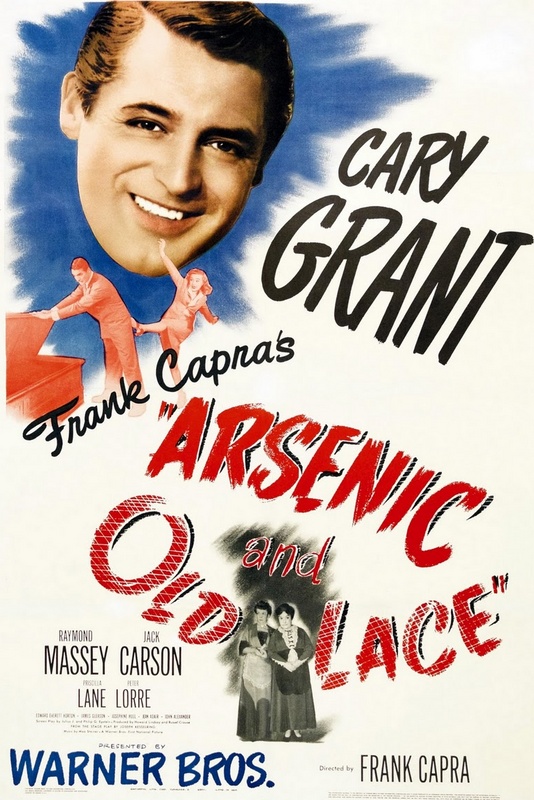
Cary Grant is great in this film adaption of the humorous play. He stops by to visit his sweet, elderly aunts and discovers that they poison men and then put them in the cellar. Other people (including police) dropping by leads to humorous situations as Grant tries to figure out what to do.
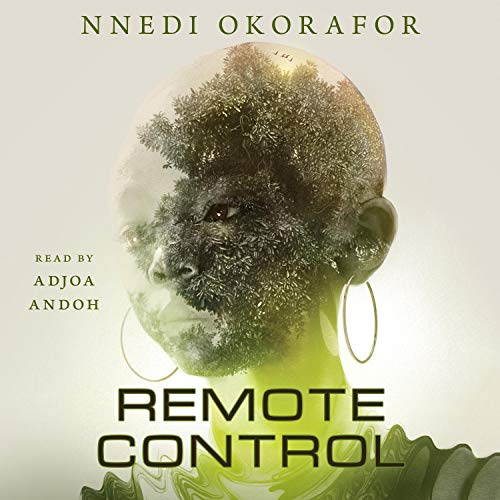
Adjoa Andoh does a great job narrating this near-future SciFi novella. A child in Ghana becomes known as the adopted daughter of death due to her ability to kill. She goes on a journey for a mysterious seed after the death of everyone in her village.
I say this with zero sense of irony or hyperbole: Starship Troopers is a masterpiece of cinema, unlike anything that has ever been put to film.
Right now you might be thinking “Really? The movie where Earth sends a space military to kill a bunch of giant bugs? Isn’t that just a dumb action movie?” If so, you wouldn’t be alone. At the time of its release in November of 1997, audiences and critics alike immediately dismissed the film as just that; a poorly acted, over-the-top, mindless gore-fest. But don’t just take my word for it; here are some of the scathing reviews that Starship Troopers received when it was released…
“Cheerfully lobotomized” – LA Times.
“Exactly like Star Wars – if you subtract a good story, sympathetic characters, intelligence, wit and moral purpose” – Washington Post.
“crazed, lurid spectacle”… “raunchiness tailor-made for teen-age boys.”- Janet Maslin, The New York Times
“a nonstop splatter-fest so devoid of taste and logic that it makes even the most brainless summer blockbuster look intelligent.”-Jeff Vice, the Deseret News
“one-dimensional,” a trivial nothing “pitched at 11-year-old science-fiction fans.” -Roger Ebert.
While I hate to admit it, I heaped my own similar criticisms at the film when it first came out. I was about twelve years old when I first saw Starship Troopers (which, in retrospect, was way too young). My dad had rented it from our local video store and, like most audiences, we were expecting a fun, sci/fi action romp; a Star Wars for this generation. I remember my excitement for it; the movie I had in my head that the previews had promised. I was fully prepared for a serious movie about tough, cool, space soldiers; the grunts fighting on the front lines of a futuristic war against hordes of giant alien bugs. I imagined it was going to be like James Cameron’s hit sequel Aliens, but with the space marines as the focus of the whole movie. When you get a sense of those expectations, it may be easy to understand why watching StarshipTroopers for the first time was bound to be a confusing and disappointing experience.
From the very opening of the film, my adolescent expectations of the movie I wanted were instantly disrupted. The movie didn’t begin with some cool action sequence, showing off how awesome this futuristic military was; nor did it begin with some scary attack from the alien monsters to set up the horror of the film. Instead, the movie opens with a futuristic military advertisement for the “mobile infantry”. The commercial speaks directly to the viewer through a booming, cartoonishly heroic voice accompanied by the corniest patriotic anthem ever composed. The narrator tells the audience to “Join Up Now” and register for the Federation’s mobile elite. The commercial’s imagery is comprised of bright, cheery visuals of happy soldiers smiling directly at the camera, proudly stating “I’m doing my part!” We see kids in a park interacting with the friendly soldiers, who allow the excited children to hold their guns as they teach them how to aim. We see a group of school children cheerfully stomping on cockroaches while their teacher gleefully applauds them. The commercial shows us that even this little bit of bug-stomping helps, as the voice and text exclaim “They’re Doing Their Part! Are You?”
A clip from the opening Military Advertisement sequence
The film had not even reached the 5-minute mark and the circuitry in my pre-teen brain was frying. What was I looking at? Why did this movie look like a cheap, after-school special or like an episode of 90210? Why was the tone so bright and campy? As the movie went on, I found myself increasingly confounded at what I was seeing on screen. The performances ranged from incredibly campy to incredibly wooden and the violence went so far with its gore that it was both extremely upsetting and laughably over-the-top. By the time the movie was finished I remember my dad and I agreeing that it had to be one of the worst movies we had ever seen. So I closed the book on Starship Troopers, concluding that it was one of the worst and most mind-boggling approaches to a movie I had ever witnessed.
Even at that time, one thing I couldn’t deny was that it was memorable; if only in the way of never forgetting which restaurant gave you food poisoning. It left a strange impact on me in a way that I could not comprehend at that time. I knew that there was something upsetting about it. The visuals painted such a sunny, sit-com level atmosphere violently juxtaposed by some of the most disturbing images of gore that my eyes had ever seen. The result was a clash that my 12 year old brain did not have the room to accept or process. So, like many others at the time, I rejected it as a dumb war movie for jocks. It would not be until I was in college that I found myself coming back and giving the movie another chance.
A fellow movie-buff friend of mine told me that Starship Troopers was one of his favorite films of all time. At first, I assumed he was joking but the more we talked, the more it was clear that I needed a serious reassessment of this film. I had already been hearing rumblings about the movie slowly gaining status as a beloved cult film. My assumptions were that people must be appreciating the film on a level of “so bad that it is actually entertaining”, but my friend assured me this was not the case. It only took my first re-watch for the movie to unfold and finally make sense to me. I wasn’t watching a movie that was failing in an effort to be a populist action film; I was watching a movie succeed as a scathing satire; a critique of fascism, and the American military industrial complex. I could see why it went over so many heads when it came out and why so many people did not understand what the film was doing. Starship Troopers is a rare film; one that is so committed to the overall narrative gimmick of its thesis, so unwilling to “break character” or give the audience a reassuring wink that it knows what it’s doing is silly, that it sacrifices people not getting the joke. While this move didn’t pay off in box office sales, it has certainly earned the film serious street cred among cine-files who champion its unwavering artistic integrity.
For those who have never seen the film, Starship Troopers is (VERY loosely) based on the Robert Heinlein novel of the same name, which was written in 1959. I say “very loosely” because, while the surface details of the plot are more or less the same, the tone and intent behind Heinlein’s book, is radically different from the film. The story of Starship Troopers (both the book and film) is set in the distant future; one where humans have mastered space travel and used it to begin colonizing other worlds outside of our galaxy. Along the way, humans came across “Klandathu”, a planet located on the opposite end of our galaxy, populated by giant, bug-like aliens. Even though these giant alien insects are extremely deadly, Earth has attempted to colonize the planet anyway, provoking the otherwise benign species to violently retaliate against them. Instead of respecting the arachnids’ home planet and cutting their losses, they present the bugs’ act of defense as an act of war and use their global government known only as “The Federation” to pump a steady stream of “anti-bug” propaganda into all forms of media. In doing so, the Federation enlists wave upon wave of young recruits into its interstellar war, all of them eager at the chance to slaughter this species completely out of existence. Primary among these young recruits is: Johnny Rico; a regular teenager from Buenos Aires who registers into the mobile infantry, against the wishes of his parents. The story follows Rico through the hardships of war, as he rises up through the ranks and becomes molded into a perfect soldier of the Federation.
Film historians may instantly notice the similarities between the plot structure of the movie and that of a notoriously well-known propaganda film called Triumph of the Will, which was made in 1935 as a recruitment tool for the Nazi party. This is no accident, but rather the whole lynch-pin of director Paul Verhoeven’s radical approach in adapting this pulp science fiction novel into a big-budget motion picture. Rather than making a straight forward adaptation of Heinlein’s story, Verhoeven, who regards the source material as “boring [and] really quite a bad book”, set out to turn Starship Trooper’s extremely jingoistic, pro-war novel on its head. While the book treats its message at face value as something cool and heroic, the film is fully aware that Heinlein’s story is a fascistic nightmare. The magic of the this choice is that, instead of attempting to “fix” these problematic elements of the book, it fully leans into them, giving the audience a full view of what Heinlein’s “perfect” facsist, authoritarian Earth would actually look like. The end result is a planet where humans have no democracy, citizenship is guaranteed only through military service, and for all the dazzling futuristic advancements they have made in technology and medicine, all it’s good for is killing bugs. The journey and eventual victory of these protagonists is therefore not meant as something for audiences to cheer, but rather, it is a cautionary tale of what America could become. Verhoeven states, “I decided to make a movie about fascists who aren’t aware of their fascism . . . this was about American politics. As a European it seemed to me that certain aspects of US society could become fascistic: the refusal to limit the amount of arms; the number of executions in Texas [etc.] . . .” (Verhoeven, as cited in How we made starship troopers, 2018). Make no mistake, the “heroes” of Paul Verhoeven’s Starship Troopers are Nazis, through and through. In one of the film’s final and most chilling moments, a commanding psychic officer stands before the “Brain Bug”, the giant slug-like monarch of the arachnid species, which has been captured and dragged out of its cave by the mobile infantry. It lays there surrounded by legions of armed Federation soldiers, trembling while this psychic officer (played brilliantly by Neil Patrick Harris) reads its mind. After a moment of silence, Harris’s psychic officer turns to the hordes of infantry men and women and proudly exclaims “IT”S AFRAID!!!!” which is met with exuberance, laughter, and practically euphoric elation from our heroes. If the film’s message had been lost on you before, this moment should make it clear: these people derive joy from witnessing the fear and suffering of their enemies.
Viewing the film now, its almost mind-boggling to know that this message seemed to sail past most American audiences, especially considering the blatant visual cues the film gives us. Take a look at Neil Patrick Harris’ character below, whose uniform is clearly a direct inspiration of the Nazi uniforms worn by the S.S.
“I borrowed from the films of Leni Riefenstahl to show that these soldiers were like something out of Nazi propaganda. I even put one in an SS uniform. But no one noticed”(Verhoeven, as cited in How we made starship troopers, 2018)
Verhoeven is a fascinating artist who brings with him an extremely unique perspective to aspects of American culture. Primarily, Verhoeven is continually drawn to our relationship with authoritarians, media consumption, patriotism, violence and fascism as can be seen in his previous films such as Robocop and Total Recall. His continued interest in exploring these themes and subjects has a large part to do with his childhood. Verhoeven is Dutch, and was born and raised under Nazi occupation of the Netherlands in the 1940s. His formative years were shaped by the most horrific display of fascism the world had ever seen and it has served to inform much of the art that he makes. In particular, much of his pitch black satirical sense of humor, his cavalier attitude towards violent imagery, and his penchant for maximalism likely all stem from being born into a place that is under Nazi rule. In this sense, I believe that Starship Troopers is oddly the most personal of Paul Verhoeven’s films. It serves to be the culmination of many of his points of interest as well as being the most direct statement against fascists in his body of work to date.
Starship Troopers is a film constructed to be two things at once. On one level the film exists as a satirical statement on the worst aspects of American patriotism and the dangers of succumbing to a militaristic rule. At the same time the movie has to exist and succeed as the very thing which it is satirizing: a big, loud, patriotic action movie. It was by design that the film would be advertised in this way; to convince American audiences (such as myself), that this was going to be a movie about our military kicking butt all over the galaxy. This appeal to our nationalistic tendencies and hunger for mindless action was, more or less, a Trojan Horse for Verhoeven to sneak in the real movie that he wanted audiences to see. That “real movie” which he successfully made is perfectly framed within the opening and closing device of the futuristic propaganda film. Verhoeven makes it clear that the entire film the audience is watching is all a part of this military recruitment advertisement. Johnny Rico and his friends, whether they are supposed to be film actors in a fictionalized recruitment ad or real people whose story is being filmed documentary style, are nevertheless all propaganda devices. By the end, we are reminded that our protagonist’s journey is structured with one goal in mind: to get you to join up into the ranks of the mobile elite. The film’s closing montage practically presents itself like that of a commercial for a series of action figures or a new video game, where you, yes-YOU, could be a hero just like the brave men and women of the Federation’s mobile elite! Are you a grunt infantry man like the heroic leader Johnny Rico? Maybe you want to be the wild man of the bunch like Johnny’s best friend Ace! Or are you the cerebral type? If so, you can be just like Carl, the Federation’s Psychic officer in the Games and Theory division. Regardless of what you are good at, the Federation will easily find a place for you. Verhoeven deftly handles these commercial sequences with the understanding of exactly how propaganda works. After all, he saw it happening first hand when he was a child.
In Verhoeven’s hands, the propaganda of this film is engineered in the same way real propaganda films work; by simplifying everything down to its basest level of black and white, good versus evil. It is articulated to prey upon our lethargy, our need for a simple, easy answer or a target to point our frustrations toward. Everything on Earth in this movie is presented as a very clean, futuristic, utopian society, down to the fact that all of our young protagonists look like living Barbie and Ken dolls. This is not an exaggeration, but rather a purposeful choice Verhoeven makes to support his overall thesis. It is also possibly his most divisive and extreme choice at that, but one which I truly believe serves to add to the film. While most movies are cast with attractive movie stars, Verhoeven’s casting process of this film was one which purposely sought out Hollywood’s most conventionally pretty actors/models, most of whom had limited acting experience. It is a choice that has its roots in the history of propaganda films as well as the visual shorthand from our oldest forms of storytelling, where all the heroes are good-looking and the villainous characters are hideous.
Most of the cast had previously acted on day time soap operas or prime-time teen romances like Beverly Hills 90210, such as two of its leads: Casper Van Dien and Denise Richards. Verhoeven chose this film’s crop of actors with the main vision that he needed actors who would have the look of people chosen for a propaganda film, and as is the case with most propaganda films, the looks would come first and would be the most important aspect. This tradition among propaganda films would typically lead to very wooden, stilted performances. Verhoeven knew that, while a potentially self-sabotaging choice for his own movie, it was an important ingredient for recreating the aesthetic of the propaganda film. His choice in casting went so far as to not even telling his actors they were making a satire because he needed his characters to believe in everything they were doing. These characters were not savvy to anything other than the world-view they had long been indoctrinated into. The end result of this choice lead to an ensemble of very limited actors, very much out of their depth, giving very campy performances, but this too is a critical component for the constructed reality of Verhoeven’s movie. He was recreating the aesthetic of these films and he recognized the performances as an extension of that aesthetic. While these choices would prove to be quite damning to the film’s immediate success in 1997, they would eventually help to preserve the film as one of the most uncompromising and bold approaches to a mainstream blockbuster film. It is very much worth noting that, since its release, Starship Troopers has had one of the greatest critical turnarounds in film history, with film fans from all over discovering it as a movie that was way ahead of its time which people are just now finally catching up to. Don’t just take my word for it, look at some of these recent reviews by critics that completely re-evaluate the film as high art…
“One of the most merciless satires of its time, Paul Verhoeven’s gung-ho, bug-squashing Reich-fest confused critics and audiences when it hit theaters in 1997; from the gruesome effects and rousing battle scenes to the insidiously quotable script (“Would you like to know more?”) and darkly stirring score, it’s just too damn well-made for its own good.”- Ignatiy Vishnevetsky, (2017) The AV Club
“… a ruthlessly funny and keenly self-aware sendup of right-wing militarism…[that] critiques the military–industrial complex, the jingoism of American foreign policy, and a culture that privileges reactionary violence over sensitivity and reason.”- Calum Marsh, The Atlantic
“The sci-fi satire arrived too early, and we’re hearing what it said 23 years too late.” – Joshua Rivera, The Verge
I won’t deny that a large part of my unbridled love for Starship Troopers comes from the odd journey I, and many others, have had with it over the years. I mean, how many films can you recall that began as the worst movie you had ever seen only to end up becoming one of your favorite movies 25 years later? On a broader level, I think a major reason why I love Starship Troopers so much is that, for me, it was the movie that completely upended my pre-existing notions of what movies were supposed to be. It challenged my way of thinking in many ways. It taught me the value of curiosity, of digging deeper into analysis before merely writing something off as “bad”. Most of all, my relationship to Starship Troopers taught me that changing my mind was not something to be embarrassed about, but to be embraced!
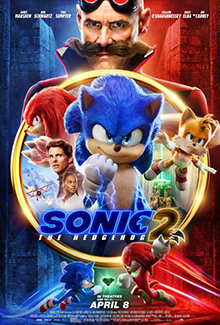
Ironically, for a movie about characters that treat the world with a simplistic black and white outlook,perhaps we have been too binary in our thinking on the films we consume. Sites like Rotten Tomatoes literally quantify a piece of art down to a percentage, awarding it either a “fresh” or “rotten” score. This site, along with social media sites such as twitter have given audiences much more of a voice and it has truly effected the film industry. Much like an algorithm, the film industry has attempted to cater to the audience’s tastes and demands. In recent years we have witnessed fan campaigns successfully force studio’s hands in releasing specific cuts of movies as well as completely reanimate a character for the entirety of a film that was already finished (Sonic the Hedgehog). While you may be glad that our blue furry friend finally resembled his video game counterpart, I cannot see this development as anything but extremely harmful to filmmaking. If I have learned anything from my humbling experience with Starship Troopers, it’s that I don’t always know what I want in a film. I may think that I do, but that very idea can change when presented with something new. In today’s “fan-driven” landscape, there is no way anything as daring, original, or as weird as Paul Verhoeven’s Starship Troopers would ever make it into theatres, let alone at the scale and budget that it was made with. The current studio approach, which seeks to cater to fan-service or create an algorithm for “quality control”, may succeed in fewer films that turn out to be bombs at the box office, but it also sets very rigid parameters on the level of creativity, ingenuity and originality that a film can have. In conclusion, I believe that I would rather have a ton of movies being made that I see and I end up hating passionately, then very well-made movies that make me feel nothing at all. Starship Troopers instilled in me the belief that any film that garners a strong response from you, positive or negative, is one that is worthy of a reappraisal, a deeper investigation, a second chance. Who knows? Maybe the worst movie you ever saw is one re-watch away from becoming an all-time favorite.
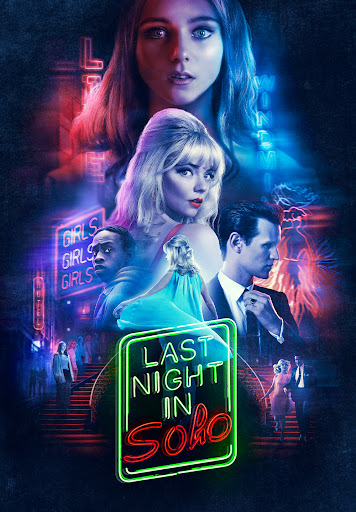
Thomasin Mackenzie (JoJo Rabbit) and Anya Taylor-Joy (The Witch) feed off each other in this unsettling paean to London’s swingin’ sixties–although it moves back and forth between past and present.
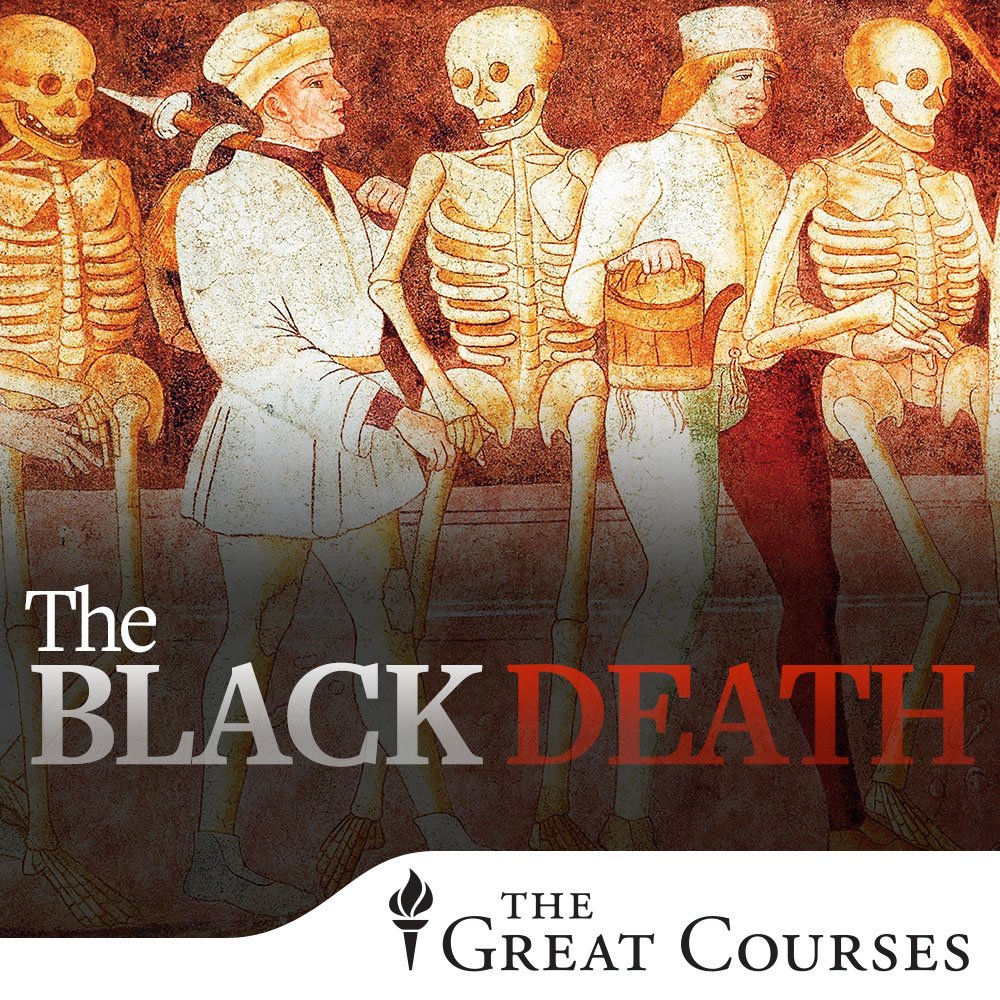
Author and narrator Armstrong is a Purdue University professor well-versed in medieval history and herein describes the plague(s) that devastated Europe in the mid-14th century and makes a cogent case for the “original” pandemic (1347-1351) as a prime cause of the Renaissance.
Licorice Pizza follows the misadventures of Alana Kane and Gary Valentine: two young people fumbling into adulthood as they bounce from one odd job to another in the San Fernando Valley of the 1970s. Masterfully directed by one of this era’s most prolific filmmakers: Paul Thomas Anderson (Boogie Nights, Magnolia, There Will Be Blood), the film will transport you to back to your own youth, no matter when you grew up. You will laugh, cringe, and maybe even shed a tear watching these two make an array of embarrassingly relatable mistakes that come with falling in love for the very first time.
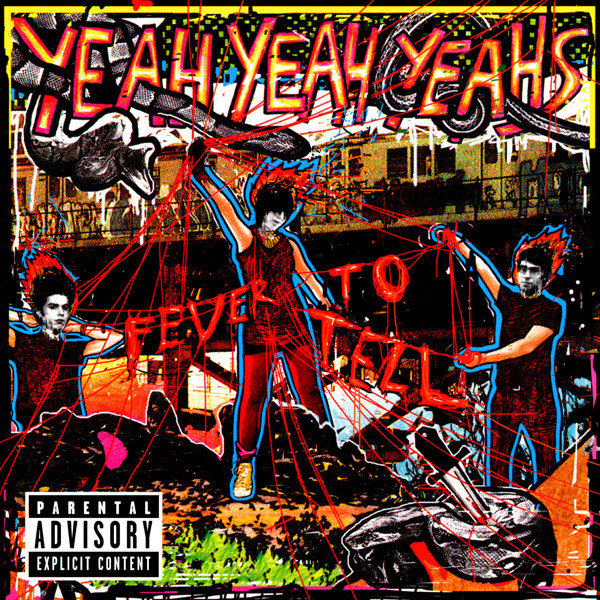
Fever to Tell is not just one of the best debut albums by a band, it may be one of the best indie-rock albums ever recorded, PERIOD. This is one of those very rare albums where every single track is an absolute banger. Tracks include: “Y Control”, “Pin”, “Black Tongue”, “Rich”, and the smash hit single “Maps”. Between her incredible vocals and her electrifying stage presence: Karen Oh remains one of the most unique frontwomen in the rock scene and this album is where it all began.
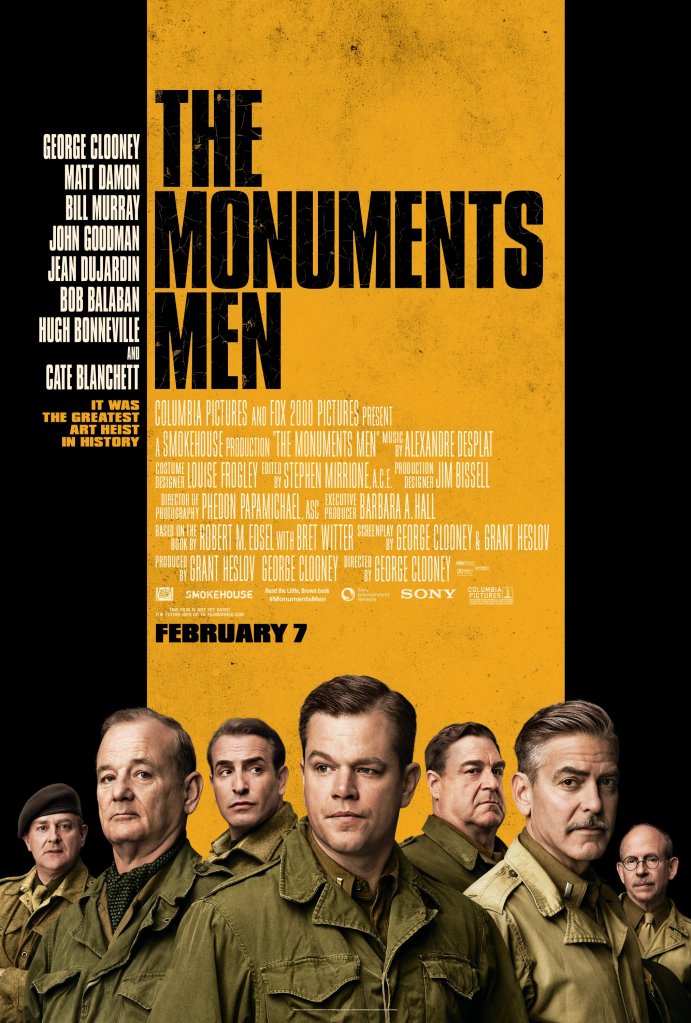
This movie, which has a great cast, is based on the true story of a group of art experts that tries to save Europe’s art masterpieces from the Nazis. If you like the movie, try the book to learn more!
The Scarlet Pimplernel is an Englishman that uses a variety of disguises and methods to save French aristocrats during the French revolution. Ralph Cosham does a great job narrating this classic with the English and French accents.
A must watch film for those interested in queer history, focusing on NYC ball culture in the 80s and tackling issues faced by Queer POC at the time.
Giovanni’s Room
A fantastic modern classic focused on the relationship between our narrator, David, and his unpredictable lover Giovanni. While this novel isn’t exactly a “feel-good” read, it is a fantastic work by one of America’s best authors.
Jessie’s Picks
The Good Thief’s Guide to Amsterdam
Charlie Howard is a writer by day and cat burglar by night. He gets hired to steal two figurines, but ends up having to prove his innocence of a murder. Simon Vance, an Audiofile Magazine Golden Voice Narrator, is the perfect narrator for this witty caper.
Downton Abbey
This movie reunites the entire cast of the TV show for a visit from the King and Queen. To fully understand the backstories, watch the TV show first. Fans of the TV show will enjoy revisiting Downton Abbey.
Kim’s Picks
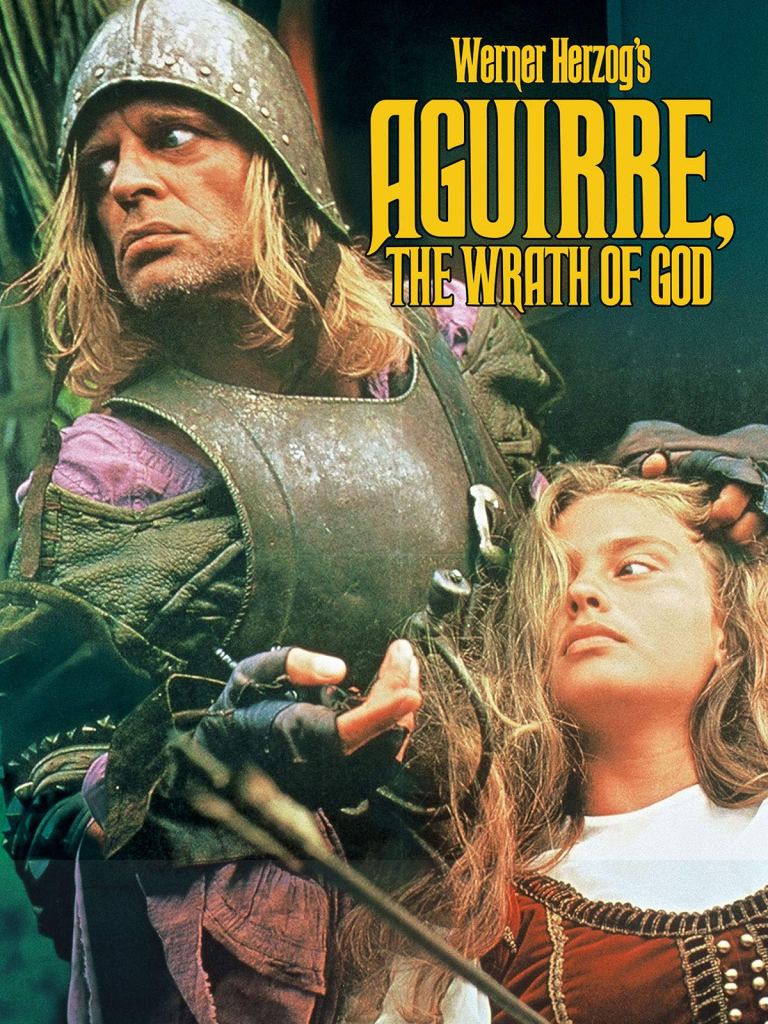
Aguirre, the Wrath of God
After Pizarro subdues the Incan empire, a troop of his men and two women descend into the Amazon rainforest and search for the fabled El Dorado, or City of Gold. The adventure does not go well.
In Which We Serve
Iconic playwright Noel Coward and fledgling director David Lean collaborated on this 1942 tribute to British sailors and their destroyer, the HMS Torrin. John Mills and Richard Attenborough make an impact. Coward is perfect as “Captain D.”
Eric’s Picks
Wet Hot American Summer
One of the absolute FUNNIEST movies featuring a murderer’s row of comedic talent before they became huge stars. The cast includes: Paul Rudd, Amy Pholer, Bradley Cooper, Molly Shannon, Janine Garofalo, Michael Ian Black, Christopher Meloni, and Elizabeth Banks in a sensational satire of summer camp films of the 70s! To this day there is nothing quite like the brand of humor director David Wain and this stacked cast cultivate in this movie. Take a trip this month to Summer Camp with this quotable summer time classic!
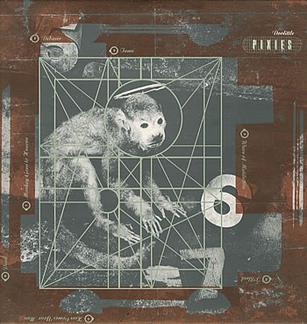
The Pixies/Doolittle
The Pixies defined a whole generation of music while simultaneously created a sound that has often been imitated but never replicated. To this day, there is no band that manages to cut straight to your ear and heart quite like the raw, emotional power of their music and there is perhaps no better example of the band than their sophomore album Doolittle. No matter how many times I hear the song “Debaser”, it remains so different, so uniquely raw, that it always manages to feel like the first time.








































 Stay Connected with Chescolibraries